
Coaching for Volleyball: Techniques, Tactics, and Mental Mastery
•MyNextCamp Team
Master coaching for volleyball with expert tactics, psychology insights, and tips to choose the right camp for your level.
Professional volleyball coaching is more than just running drills; it's about architecting a complete player. It’s a structured methodology that goes beyond how to bump, set, and spike to understand the why behind every movement, strategy, and decision on the court. It’s a partnership dedicated to unlocking your peak potential.
What to Expect From Professional Volleyball Coaching
Stepping into a professional coaching environment is a commitment to seeing the bigger picture of your game. A good coach will quickly identify your strengths and, more importantly, pinpoint the weaknesses holding you back, then create an actionable roadmap for improvement. This is miles away from just hitting serves over the net; it's about learning the intricate dance of offence, defence, and teamwork that defines high-level volleyball.
The best coaching builds players from the foundation up. A great coach is like an architect—they start by making sure your fundamental skills are rock-solid before adding the more advanced, complex parts of the game on top. This methodical process is what truly separates casual play from competitive excellence.
The Four Pillars of Elite Development
Effective volleyball coaching is almost always built around four critical areas. Each pillar supports the others, and together they create a balanced, formidable athlete who’s ready for anything the game throws at them.
This diagram breaks down how these core components fit together.
As you can see, true player development isn’t just about one thing. It's the combination of skills, tactics, fitness, and mindset, all guided by an experienced coach.
For any serious player, these four pillars are non-negotiable:
- Technical Skills: This is the nitty-gritty mechanics. We’re talking about the precise angle of your passing platform, the snap of your wrist on a serve, and the footwork for a perfect approach.
- Tactical Awareness: This is your "volleyball IQ." It’s about understanding court positioning, reading an opponent's attack before it happens, and making smart, split-second decisions under pressure.
- Physical Conditioning: Volleyball is a game of explosive power, agility, and endurance. Proper coaching integrates strength and conditioning to make sure your body can keep up with your ambition, game after game.
- Mental Toughness: The best coaches are part-time sports psychologists. They teach you how to handle pressure, stay locked in when the score is tight, and bounce back instantly from an error.
A coach's real job is to see the player you can be, not just the player you are today. They push you to unlock a potential you might not even know you have. Understanding what makes a coach qualified is crucial, which is why we put together a guide on what to look for in beach volleyball coach certifications.
How Coaching Adapts to Different Skill Levels
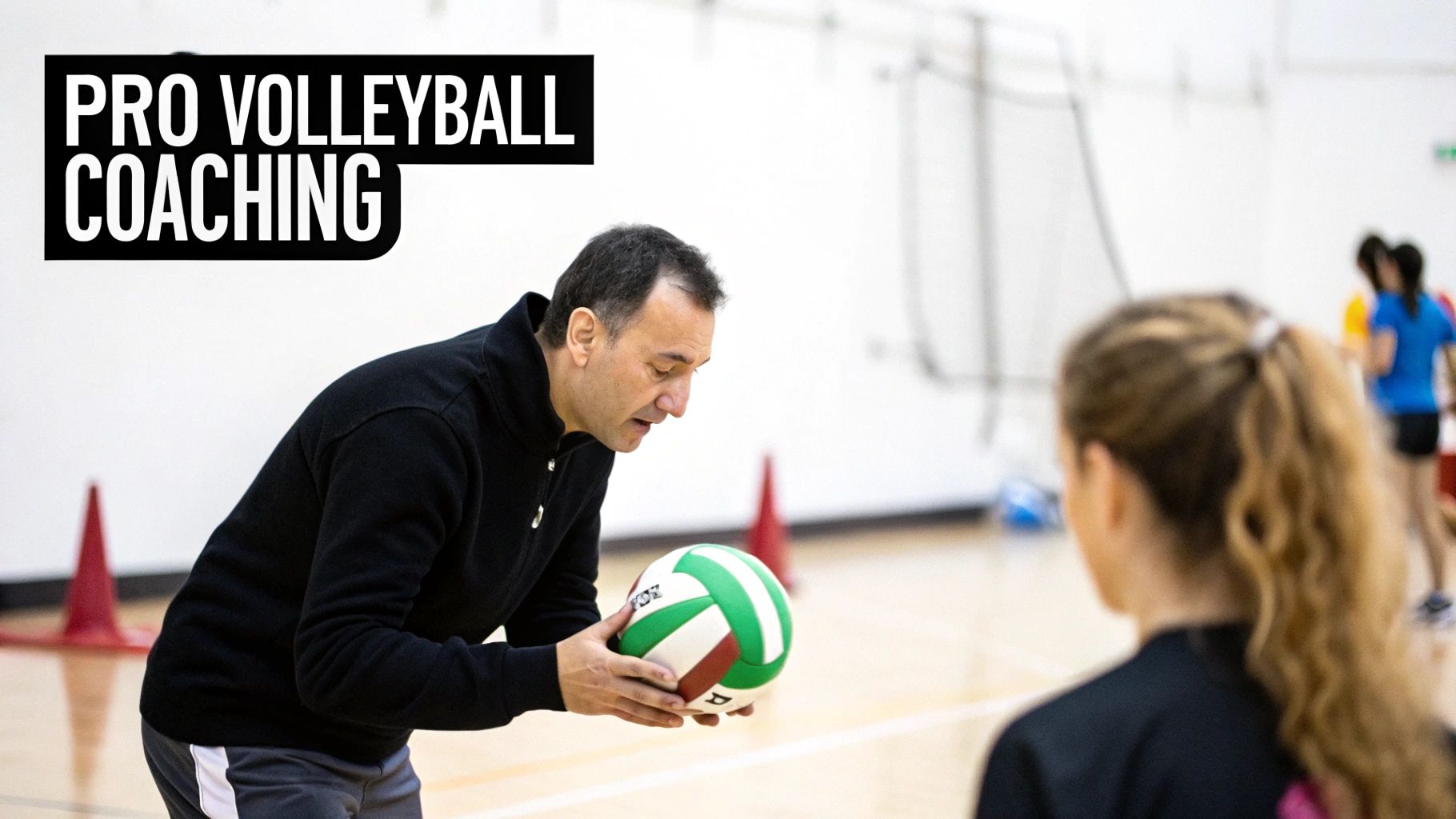
Great volleyball coaching isn’t a one-size-fits-all programme. Far from it. The best coaching is a dynamic approach that adapts to where you are on your volleyball journey. Think of it like a personal trainer: you wouldn't give a total beginner the same workout as a seasoned athlete. A great coach meets you where you are, ensuring you're always challenged but never completely overwhelmed. This is the sweet spot for real, steady progress.
For players just starting out, the focus is all about building a solid foundation. This means drilling the absolute essentials: correct footwork, creating a stable passing platform, and understanding the basic mechanics of serving. The goal here is pure consistency and muscle memory, making sure good habits are baked in from day one.
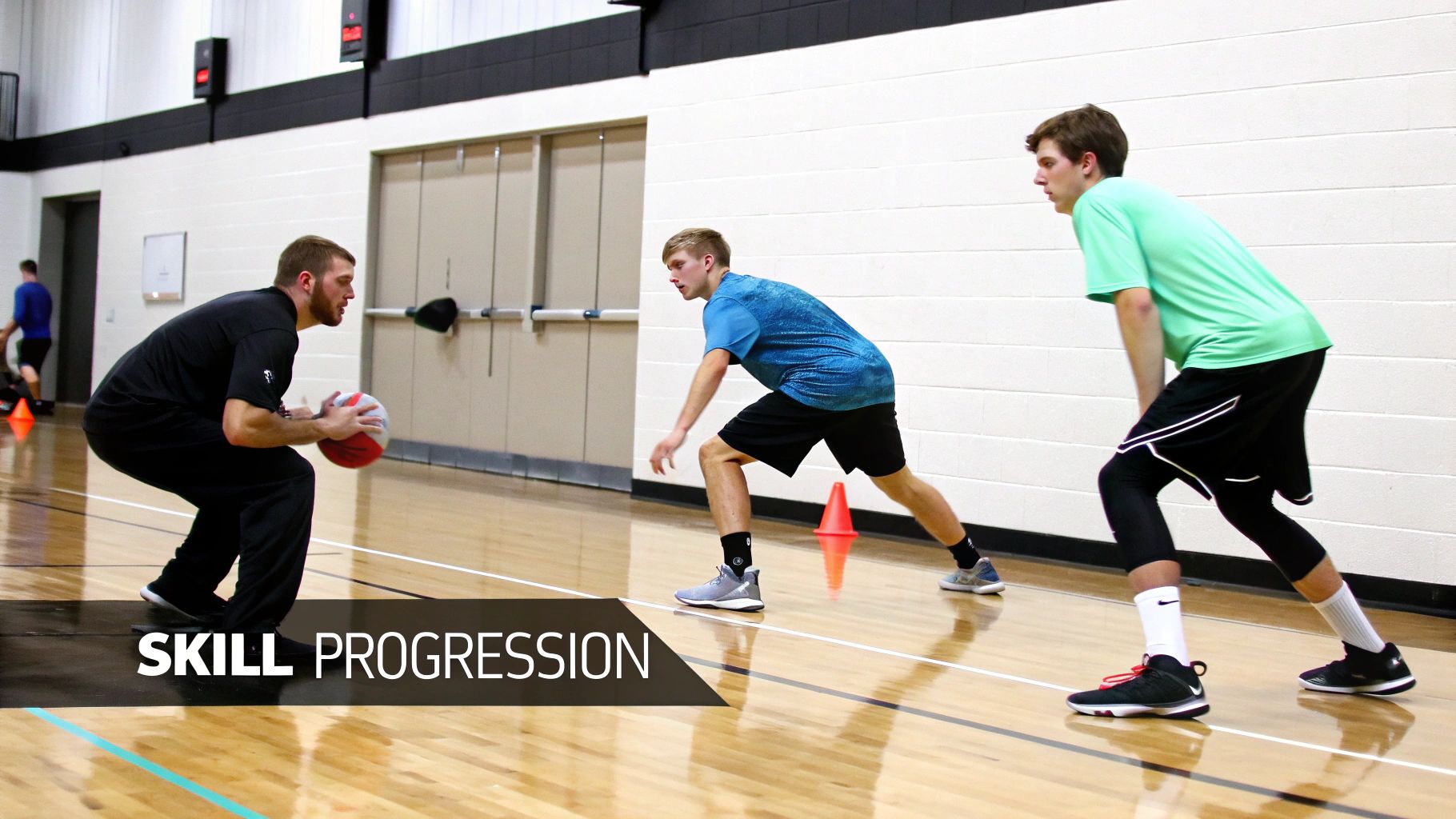
As players grow and hit that intermediate phase, the coaching gets more nuanced. The fundamentals are still vital, but the emphasis shifts towards refining those skills and applying them in game-like situations. This is where you start linking individual skills together into fluid, effective actions on the court.
From Fundamentals to Advanced Strategy
At the intermediate level, a coach will start weaving in more complex tactical ideas. You'll move beyond just getting the ball over the net to learning how to control it with purpose. This means working on shot selection, understanding defensive positioning, and speeding up your decision-making under pressure.
Advanced athletes, on the other hand, are getting coached on a different plane altogether—it's highly strategic and mentally focused. The assumption is that their technical skills are already polished. So, training zeroes in on finding that competitive edge. We're talking sophisticated offensive plays, detailed scouting of opponents, and mastering the psychological side of the game.
Let’s look at how a simple passing drill evolves for each level:
- Beginner: The coach might toss balls from a stationary spot, focusing only on the player's body shape and creating a consistent platform to bump the ball to a large, forgiving target.
- Intermediate: The drill gets tougher. Now, serves are coming from across the net. The focus expands to include reading the server's motion, moving efficiently to the ball, and passing with much better accuracy to a specific setter’s position.
- Advanced: The drill becomes a full-blown game simulation. The coach might use multiple servers, vary the spin and speed, and demand that the player communicates with teammates while executing a perfect pass that kicks off a specific offensive play.
The most effective coaching identifies the one or two key adjustments that will unlock your next level of performance. It's about targeted, incremental gains that build into massive long-term improvement.
The Role of Sports Psychology
Across all levels, but especially for advanced players, sports psychology becomes a huge piece of the puzzle. When physical skills start to even out among top competitors, it's the mental game that often decides who wins. Coaches will integrate techniques to build resilience, maintain focus in those nail-biting moments, and foster unbreakable trust between partners.
This mental training can be anything from visualisation exercises to controlled breathing techniques that help manage adrenaline. According to the experts at NBC Volleyball Camps, something as simple as deep belly breathing can seriously lower stress between points, letting you hit a quick mental reset button. High-level coaching for volleyball understands that a calm, focused mind is a player's most powerful weapon.
Mastering Beach Volleyball Team Tactics
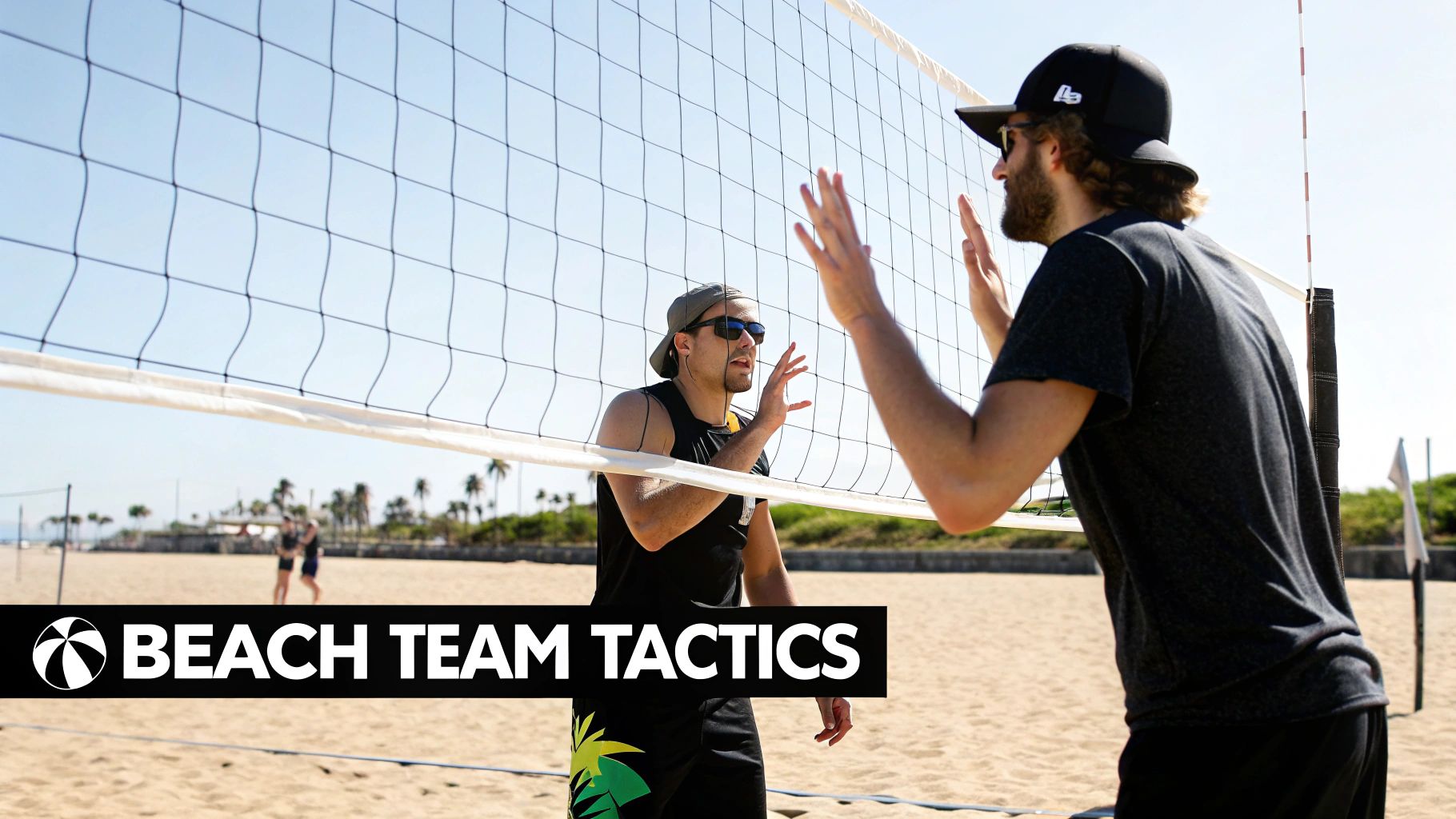
Beach volleyball isn't just a sport; it's a two-person chess match played on sand. With only you and a partner covering the entire court, there’s absolutely nowhere to hide. Every move, every hesitation, every decision gets amplified. Success boils down to tactical smarts, constant communication, and a shared sixth sense for space and strategy.
This is where a good coach makes all the difference. Expert coaching for volleyball doesn't just refine your individual skills—it teaches you the art of the partnership. The goal is to build a system where you and your teammate move like a single, seamless unit, anticipating each other’s moves without a second thought.
Building an Unbreakable Communication System
Communication is the absolute lifeblood of any serious beach volleyball team. It’s a mix of silent signals and quickfire verbal cues that let you coordinate your entire game in milliseconds. Without a solid system, you’re just two talented individuals scrambling on the sand, not a team.
Here's an actionable breakdown:
- Hand Signals: The blocker flashes signals behind their back to tell the defender which area they will take away. A single finger often signals a "line" block, while two fingers mean "angle" or "cross-court". The key is consistency.
- Verbal Cues: Simple, loud calls like "Mine!" or "Got it!" prevent costly confusion. Advanced teams develop specific calls for shots like "Line!" or "Cut!" to give their partner a split-second advantage in reading the attacker's next move.
- In-Rally Adjustments: Great teams communicate during a point. A simple "Watch the shot" from the defender can remind the blocker to pull off the net and dig. This constant feedback loop is what makes a defense truly dynamic.
Defensive Philosophies and Court Coverage
Defence in beach volleyball is all about playing the odds. With so much sand to cover, coaches teach you how to position yourself for the highest-probability shots. It’s a constant process of reading your opponent's habits and adjusting your defensive shape to counter them.
A huge part of this revolves around the blocker. Do they commit to a full block at the net to shut down a hard spike? Or do they pull off to help dig a softer shot? This decision often hinges on the quality of the set and the attacker’s approach. For a deeper dive into what makes a good set, check out our guide on understanding sets in volleyball.
The core idea of beach defence is pretty simple: make your opponent hit the shot you want them to hit. By taking away their favourite angle with your block and positioning, you shrink the court for them and tilt the odds in your favour.
Crafting a Deceptive Offensive Attack
When you're on the attack, being predictable is your worst enemy. Top-tier coaching is all about building a deep arsenal of shots that keeps the defence constantly guessing. Hitting the ball hard is great, but hitting it to the open sand is what scores points.
A truly well-rounded attacker has a few key shots they can rely on:
- High Line Shot: A powerful hit aimed deep into the back corner, right over the defender’s head.
- Cut Shot: A sharp, angled attack that lands just inside the sideline, often catching the defence off guard.
- Poke or "Jumbo": A soft, tactical shot placed with touch just over the blocker's hands into the empty space behind them.
Once you master these shots and learn how to read the defence in front of you, you can start exploiting weaknesses and scoring points even from a less-than-perfect set. This strategic variety is what separates the good players from the great ones. For some great visual examples, check out the pro tips from organisations like the AVP.
Building Mental Toughness with Sports Psychology
Volleyball isn't just won with powerful serves and perfectly timed blocks; it's often decided in the six inches between your ears. Excellence on the court is as much a mental game as it is a physical one, and any top-tier coaching for volleyball worth its salt will integrate sports psychology to build the resilience, focus, and confidence needed when the pressure is highest.
It’s all about training your mind to be as disciplined as your body. A good coach can teach you how to maintain that crucial 'next point' mentality after an error, helping you shake it off instantly instead of letting one mistake snowball into three. This mental reset is a skill, and just like passing or serving, it needs dedicated practice to master.
Developing In-Game Focus and Resilience
One of the most powerful tools a coach can give you is a set of techniques for managing stress during those make-or-break moments. When the score is tied 14-14, the ability to stay calm and execute is what separates good players from great ones. Visualization, for instance, is a simple but potent technique where you mentally rehearse successful plays before they even happen.
This kind of mental practice actually builds neural pathways that make success feel more familiar and achievable under pressure. Another key strategy is developing pre-game mental routines. Think of it this way: just as a physical warm-up gets your muscles ready, a mental warm-up gets your mind locked in for competition.
"A calm, focused mind is a player's most powerful weapon. Learning to control your breath is one of the fastest ways to control your mental state and stay present in the game."
Actionable Mental Training Techniques
Coaches will often introduce simple yet effective mental triggers to help you stay anchored in the present moment. These are small, repeatable actions that act as a reset button when your focus starts to drift.
Here are a few actionable tips that elite coaches use all the time:
- Box Breathing: This is a structured breathing technique designed to calm your nervous system right down. Inhale for four seconds, hold for four, exhale for four, and hold for four again. It's perfect for timeouts or between sets to clear your head.
- Focus Triggers: A simple physical cue, like touching your wristband or taking one deliberate deep breath just before you serve. This small action signals to your brain that it’s time to lock in and concentrate only on the task at hand.
- Positive Self-Talk: It’s about consciously replacing negative thoughts (like "Don't miss this serve") with positive, instructional ones (like "Toss, step, and contact high"). This keeps your focus on execution, not on the fear of failure.
Fostering Unbreakable Partner Trust
In beach volleyball, the mental game isn't just about you—it extends to the dynamic between you and your partner. Trust and communication are absolutely everything. A great coach doesn't just work with individual players; they coach the team as a single, unified entity, helping to foster an unbreakable bond on the sand.
They’ll guide conversations about strategy, establish clear communication protocols for in-game calls, and teach you both how to support each other after an error. This shared mental toughness ensures that when the game gets tough, the team gets stronger, not weaker. One great way to build this bond is by incorporating fun drills into your practice; for some fresh ideas, check out our guide on engaging games for volleyball practice.
How to Choose the Right Volleyball Camp
Picking the right volleyball camp is probably the single biggest decision you’ll make in your training journey. It's the difference between a massive leap forward and a week of wasted time and money. A flashy website doesn't tell you much; you have to dig into the details that actually make a camp work.
A truly great camp experience lives and dies by its coaching staff. It’s not about how well a coach played back in the day—it’s about how well they can teach, communicate, and light a fire in their players. This is where you need to roll up your sleeves and do some homework before you commit.
Evaluating Coaching Credentials and Philosophy
First things first: who are the coaches? A good camp will be proud of its staff and should make it easy to see their credentials, whether that's official certifications, experience coaching at the collegiate level, or a pro playing career. You're looking for coaches who not only know the game inside and out but have a real track record of making players at your level better.
The best coaches don’t just run drills; they build systems. Their philosophy should be evident in how they structure practices, communicate with players, and foster a competitive yet supportive atmosphere.
This philosophy piece is massive. Is the camp all about high-rep drills to hammer in perfect technique, or does it focus more on game-like situations and strategy? Neither is right or wrong, but one will absolutely suit your goals better than the other. The camp's core philosophy shapes the entire week.
Key Metrics for Camp Quality
Beyond the coaches' CVs, a few practical details can tell you a lot about a programme's quality. These are the things that determine how much real, individual attention you’ll get.
Here are the big ones to check:
- Coach-to-Player Ratio: This is a huge giveaway. A low ratio, something like 1 coach for every 8 players, means you'll get way more direct feedback. A high ratio, and you'll probably feel lost in the crowd.
- Use of Video Analysis: Modern coaching for volleyball uses technology. Camps that film you and break down the footage offer a powerful learning tool. Seeing your own technique is often the fastest way to understand what needs to change.
- A Detailed Training Schedule: Ask for a sample weekly plan. A good one will show a smart balance of skill work, tactical sessions, conditioning, and actual competitive play. It proves they've put real thought into your development, not just winging it.
Looking at successful coaches is a great way to know what to look for. Take Craig Skinner at the University of Kentucky. He built a powerhouse, leading the team to 21 straight NCAA Tournament appearances and a stack of SEC titles. That kind of long-term success comes from world-class player development and tactical smarts—exactly the qualities you want to see in a camp's leadership.
Ultimately, the best camp is the one that fits you. If your focus is more on the sand than the hardcourt, you might want to check out our guide on how to find the perfect beach volleyball camp.
By weighing these factors, you can find a camp that doesn't just meet your expectations but genuinely pushes you closer to your goals.
Finding and Booking Your Ideal Volleyball Camp
Alright, you’ve got a handle on coaching styles, the mental game, and what makes a great programme tick. Now for the fun part: putting that knowledge to work and actually finding the perfect camp. It can feel like a massive task, but if you break it down, it's actually pretty simple. The goal is to turn that ambition into a booked spot on the court.
First things first, you need to know what you’re looking for. Are you a total beginner who needs to lock down the fundamentals, or an advanced player hunting for high-level tactical training? Your skill level, where you want to go, and when you’re free are the big three. Nailing these down will instantly shrink a list of hundreds of camps down to a handful you can seriously consider.
This is your chance to get specific about the kind of coaching for volleyball you need. Do you learn best with lots of one-on-one feedback? Or do you thrive in a camp that’s all about competitive match play? Defining your priorities right at the start will save you a ton of time later.
Using Smart Tools to Compare and Plan
Once you have a shortlist, the real evaluation starts. Forget juggling a dozen open browser tabs. Modern platforms let you compare camps side-by-side, which is an absolute game-changer for making a smart choice. You can weigh up all the important stuff at a glance: price, what’s included (coaching, accommodation, meals), and the daily training schedule.
A timeline view is another brilliant feature. It helps you see your whole trip laid out, which is a lifesaver if you're trying to sync up with friends or need to book your own flights and digs. It takes the planning process from a spreadsheet headache to a clear, organised map.
As you plan, keep these practical points in mind:
- Booking Windows: The early bird really does get the worm. Popular summer camps often fill up 3-6 months in advance. Don't leave it to the last minute if you have your heart set on a specific one.
- Early-Bird Discounts: Most camps reward planners with lower prices for booking early. Set up alerts for the camps you’re eyeing—it’s a simple way to get a heads-up on deals and save some cash.
- What’s Included: Always read the fine print. Does that price tag cover just the court time, or are meals, airport transfers, and evening activities thrown in too? Knowing this upfront helps you budget properly and avoid any nasty surprises.
The best way to choose a camp is to look at the hard data. Compare the coach-to-player ratio, the number of training hours per day, and the specific skills they focus on. This data-driven approach is your best bet for ensuring a camp truly matches your development goals.
Securing Your Spot
After you've compared your top contenders and sorted out your budget, there’s only one thing left to do: book it. This is the moment you commit to getting better and lock in an amazing volleyball experience. The process should be dead simple, turning all your research into a confirmed spot.
Think of it as the final play of a long rally. You’ve read the game, weighed your options, and now you’re making the decisive move. Follow these steps, and you can confidently find and book the camp that will take your game to the next level and leave you with great memories from the court.
Ready to find the perfect volleyball camp without the usual hassle? MyNextCamp pulls together over 577+ camps and clinics from across the globe, letting you filter, compare, and plan with ease. Start your search today at mynextcamp.io.
34 views
Find Your Next Camp
Compare beach volleyball camps across Europe. Filter by country, dates, and price.