
Guide to beach volleyball coach certifications explained
•MyNextCamp Team
Your quick, clear guide to beach volleyball coach certifications explained: discover paths, costs, and benefits for UK and international qualifications.
So, what exactly is a beach volleyball coach certification? Think of it as a formal training programme that confirms a coach really knows their stuff—not just in technique and strategy, but in safety too. It provides a proper framework covering everything from the absolute basics to advanced team tactics and sports psychology, making sure coaches can develop players safely and effectively. This guide offers actionable insights into what certifications mean for you and how to get them.
Why Coach Certifications Matter in Beach Volleyball
Before we get into the different courses and levels, it’s worth understanding why a formal certification is so much more than a piece of paper. It’s a genuine commitment to a higher standard of coaching. It signals a move beyond simply knowing the game to truly understanding how to teach it—safely, effectively, and ethically. For any coach, new or experienced, it’s the blueprint for success.
A certified coach has been trained in a proven system. This structured education means they can build a solid programme that benefits every single player, no matter where they're starting from. It gives them a toolbox filled with more than just drills; it’s packed with the crucial elements of holistic athlete development.
The Pillars of Certified Coaching
Great coaching goes way beyond demonstrating a perfect cut shot. Certification programmes are designed to build real expertise in several key areas that have a direct impact on how players grow and how teams succeed.
- Advanced Team Tactics: Coaches learn to implement sophisticated offensive and defensive systems. This covers everything from setter-hitter communication and creating offensive flow to strategic blocking schemes designed for different opponents. Actionable tactics, such as recognizing opponent tendencies and adjusting defensive positioning mid-match, are core components of advanced certification.
- Player Safety and Well-being: A core part of any reputable certification is safeguarding and first aid. Coaches are trained to create a secure environment, spot potential risks, and know exactly how to respond to injuries.
- Sports Psychology: The mental game is huge in beach volleyball. These courses provide practical insights into building player confidence, managing the anxiety of competition, and fostering resilience so athletes can perform under pressure. For deeper insights into mental toughness, check out resources from experts like Dr. Jim Loehr, co-founder of the Johnson & Johnson Human Performance Institute.
It’s a common myth that great players automatically make great coaches. In reality, coaching is a totally different skill. Certification bridges that gap by teaching how to communicate complex ideas, adapt to different learning styles, and manage the psychological burdens athletes carry.
Setting a Standard of Excellence
Governing bodies like Volleyball England and the global authority, FIVB (Fédération Internationale de Volleyball), are central to this whole process. They’re the ones who establish and maintain the standards for coaching qualifications, ensuring there's consistency and quality across the sport.
For players and parents, a coach’s certification is a reliable sign of their competence and professionalism. When you see a coach is officially certified, you can feel confident that your investment in training is backed by a recognised and respected framework. That credential signals a real dedication to excellence and continuous improvement—setting the stage for a positive and impactful journey in the sport.
Your UK Coaching Pathway with Volleyball England
If you're looking to become a certified coach here in the UK, your journey starts with Volleyball England. They’re the national governing body, and they've laid out a clear, structured path to take you from your first day on the sand to coaching at the highest levels.
Think of it as a ladder. The first rung is accessible to anyone—parents, volunteers, or seasoned players ready to share their knowledge. There's no prior coaching experience required. As you climb, each level builds on the last, introducing more advanced concepts and refining your skills.
This isn't just about learning a few drills. It's a proper deep dive into the art and science of coaching. Early on, you'll focus on individual skills, but as you progress, the curriculum expands to cover sophisticated beach volleyball tactics as a team. You’ll learn how to read the game, make smart adjustments mid-match, and develop strategies that win points.
The Foundational First Step
Every great coaching career has to start somewhere, and in the UK, that place is the Assistant Coach Award. This course is your gateway into the official framework, designed to give you the core skills needed to effectively support a lead coach. It’s the perfect entry point.
You’ll walk away knowing how to:
- Organise Activities: Set up and run drills that are safe, fun, and actually improve players.
- Communicate Effectively: Give clear, constructive feedback that players can understand and apply.
- Create a Positive Environment: Use basic sports psychology to build confidence and make sure everyone enjoys the session. A great actionable tip is to use the "feedback sandwich" method: start with a positive comment, provide constructive criticism, and end with encouragement.
Once you’ve passed, you’ll be a genuine asset to any club or camp. You’ll have a solid foundation to build on before you take the lead yourself. This is where your journey through the world of beach volleyball coach certifications explained by Volleyball England really kicks off.
Specialising with the Beach Coach Award
With the fundamentals under your belt, it’s time to specialise. The Beach Coach Award is where you leave the general principles behind and focus entirely on the sand. This is all about the unique demands of the two-a-side game.
It’s a dedicated pathway for those truly passionate about the beach discipline.
The course covers everything that makes beach volleyball its own sport—the tactical nuances of playing with a single partner, managing the wind and sun, and mastering movement on an unstable surface.
The demand for this specialisation is growing fast. The very first Beach Coach Award course run by Volleyball England attracted 15 dedicated learners. That’s a strong start, showing just how much the sport is booming across the UK.
Completing this award sends a clear message: you aren’t just a volleyball coach who happens to be on the sand; you are a genuine beach volleyball specialist. If you're curious about Volleyball England's wider role in the sport, you can check out their organiser profile here.
Reaching the Top with the Beach Head Coach Award
For coaches with big ambitions—those who want to lead high-performance programmes and develop elite athletes—the pinnacle is the Beach Head Coach Award. This is the top tier of the UK coaching pathway.
The Head Coach qualification is about more than just running a good practice. It’s about becoming a programme architect. You learn to think in terms of season-long plans, identify top talent, and build a winning culture that lasts.
This course dives deep into advanced sports psychology, performance analysis, and mentoring other coaches. It’s designed to prepare you to lead a club, manage a performance squad, and help shape the future of beach volleyball in the UK. Earning this qualification marks you as a true leader in the coaching community.
Going Global: Earning Your FIVB Certification
For any serious coach in the UK, mastering the national pathway is a fantastic starting point. But if you’ve got your sights set on the international stage, the next step is the Fédération Internationale de Volleyball (FIVB). This is the globally recognised gold standard for coaching. An FIVB certification isn't just another line on your CV; it's your passport to coaching on professional tours, running high-performance international camps, and joining a worldwide network of elite coaches.
Think of it this way: your national certification proves you know the game. An FIVB credential shows you can coach it at the highest level, anywhere in the world. This pathway is built for coaches who have already put in the work at home and are ready to level up. The FIVB curriculum builds on that foundation, introducing world-class methodologies that shift the focus to the razor-thin margins of elite international competition.
The courses are intense but incredibly rewarding. You'll move beyond fundamental drills and dive deep into advanced offensive systems, complex defensive schemes, and cutting-edge sports science. It's about learning how to prepare athletes for the unique physical and mental grind of international travel and competition.
Understanding the FIVB Levels
The FIVB structures its coaching education into clear, progressive levels. Each one represents a significant jump in expertise and responsibility. For most, the journey starts with Level 1.
- FIVB Coach Level 1: This is the international entry point, designed for coaches working with developing athletes. The focus here is on perfecting technical fundamentals and introducing solid beach volleyball tactics as a team. It ensures you can build players from the ground up using proven international methods.
- FIVB Coach Level 2: To get here, you need to prove your worth with real-world experience after completing Level 1. This advanced course is for coaches working with national-level and professional athletes. The curriculum gets serious, focusing on high-performance strategy, sophisticated video analysis, and advanced sports psychology techniques for managing elite players under pressure.
The difference is simple: Level 1 makes you a world-class developer of talent. Level 2 qualifies you to manage and elevate that talent on the world stage.
Your Roadmap to International Credentials
For a UK-based coach, getting an FIVB certification requires a plan. Your national qualifications are the launchpad. Volleyball England will typically need to endorse you for an FIVB course, which serves as proof that you have the necessary knowledge and experience to even be in the room.
The courses themselves are immersive, often run as intensive, multi-day seminars that bring together coaches from all over the globe. It's an incredible environment for networking and getting exposed to different coaching philosophies. While many pro circuits value experience above all, an FIVB credential can unlock doors that might otherwise stay shut—much like the opportunities provided by major organisers like AVP America for coaches and players in the US.
An FIVB certification signals that you speak the universal language of high-performance beach volleyball. It tells athletes and federations that your approach to training, tactics, and player development meets the highest international standard.
The best way to start is by heading straight to the source: the FIVB's technical and coaching resources. Their site has all the details on course schedules, prerequisites, and how to apply. It’s your first step in creating a clear, actionable plan to take your coaching career from a national success story to a globally recognised force in the sport.
Breaking Down The Course Costs And Commitments
Getting certified as a beach volleyball coach is a serious investment. And I’m not just talking about money—it’s a big commitment of your time and energy, too. Before you jump in, it’s really important to get a clear picture of what’s involved, from the course fees to the hours you’ll spend on and off the sand.
Let's start with the obvious: the financial side. The cost of a certification can swing wildly depending on who’s running the course and what level you’re aiming for. An entry-level qualification might set you back a few hundred pounds, but a top-tier, internationally recognised one could easily run into the thousands.
But the sticker price is just the beginning. You’ve got to think about all the other little costs that sneak up on you.
Budgeting For Your Certification Journey
Thinking through the total investment will save you a lot of headaches later. Beyond the registration fee, a proper budget needs to account for a few other things that can add up fast.
- Travel and Accommodation: High-level courses, in particular, are rarely held down the road. You’ll likely need to factor in flights or fuel, plus a few nights in a hotel.
- Equipment and Gear: While it's not always required, you'll probably want your own coaching tools like balls, cones, and a clipboard. And don't forget decent clothing for all kinds of weather – you’ll be on the beach, after all.
- Membership Fees: To even sign up for a course, you often need to be a member of the governing body (like Volleyball England), which usually means an annual fee.
- Renewal and CPD: Certifications aren’t a one-and-done deal. To keep your qualification active, you’ll need to do ongoing training, known as Continuing Professional Development (CPD), which comes with its own costs.
Understanding The Time Commitment
Just as crucial as the money is the time you need to block out. A certification course isn't just a one-day workshop; it's a whole process designed to build well-rounded coaches through a mix of learning styles.
You can expect a blend of classroom theory and practical, on-sand sessions. The classroom is where you'll get into the nitty-gritty of coaching philosophy. This is where concepts like beach volleyball tactics as a team are mapped out on a whiteboard, and where you'll explore the basics of sports psychology.
Then you hit the sand. The practical sessions are where it all comes together. You’ll be learning how to demo techniques properly, run drills that actually work, and give players feedback they can use right away. This blended approach makes sure you don’t just know what to teach, but how to teach it.
The flowchart below gives you a sense of a common pathway for a coach with big ambitions, starting with a UK national qualification and moving up to the global FIVB standard.
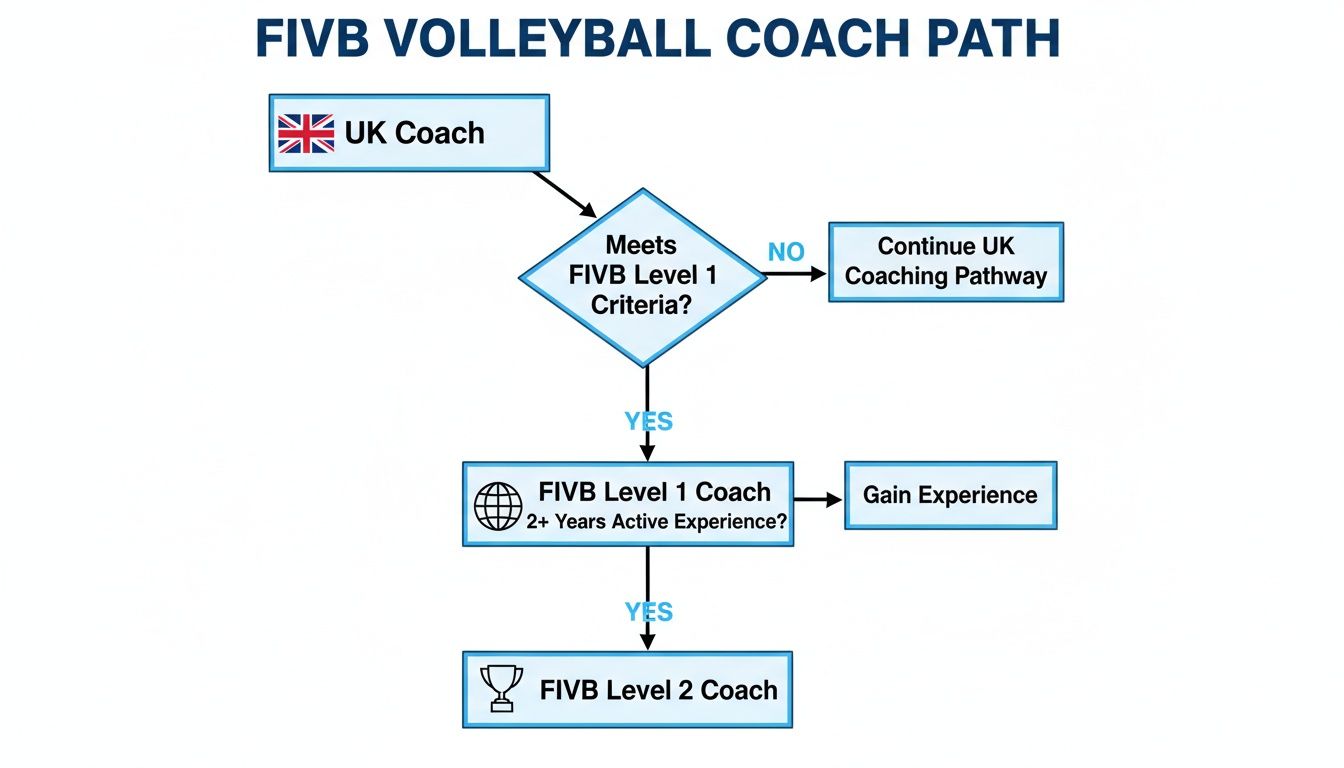
This kind of roadmap shows how each certification builds on the last, creating a clear ladder for you to climb in your coaching career.
Comparison Of Key Beach Volleyball Coach Certifications
To help you figure out what’s right for you, it’s useful to see the main options side-by-side. Each certification is built for a different kind of coach—from the parent helping out on weekends to the professional aiming for the elite tour. The table below breaks down the key entry-level and advanced certifications from Volleyball England and FIVB, giving you a snapshot of what to expect.
| Certification Level | Governing Body | Typical Candidate | Core Focus | Estimated Cost & Duration | Key Outcome |
|---|---|---|---|---|---|
| Introductory | Volleyball England | New coaches, parents, club volunteers | Fundamentals of coaching, basic skills, safety | £100-£200 / 1-2 days | Qualified to assist a head coach at a local club or camp. |
| Beach Head Coach | Volleyball England | Experienced club coaches, aspiring performance coaches | Advanced tactics, season planning, athlete development | £400-£600 / 2-3 weekends + assessment | Certified to lead a club or development programme independently. |
| FIVB Level 1 | FIVB / National Federation | National-level coaches, former professional players | International standards, technical models, youth development | £800-£1,200 / 5-7 days | Globally recognised credential for coaching national youth teams. |
| FIVB Level 2 | FIVB / National Federation | Professional coaches working with elite athletes | High-performance strategy, physical conditioning, analytics | £1,500+ / 7-10 days | Elite qualification to coach senior national and professional teams. |
This comparison should give you a better idea of which path lines up with your goals, your wallet, and your calendar. For example, Volleyball England has been making a real push to professionalise coaching in the UK, with initiatives like the new Beach Head Coach award. They even offered funded spots for over 40 coaches to get them through the programme.
Once you're certified, you'll be in a great position to find the perfect coaching gig. To see how your new qualification fits into the bigger picture, check out our ultimate guide to finding the right beach volleyball camp.
A certification isn’t just an expense; it's an investment in your credibility and effectiveness. The right course provides a framework that elevates your coaching, giving you the confidence to develop athletes and manage complex team dynamics with proven strategies.
By weighing the costs and time against the skills and opportunities you'll gain, you can choose a certification path that makes sense for you and your coaching ambitions.
How Certification Elevates Your Coaching Career
Getting certified is far more than just ticking a box or adding a line to your CV. Think of it as a catalyst for your entire coaching journey—a move that sharpens your skills and, just as importantly, serves as a guarantee of quality for players and parents. For a coach, a formal qualification means instant credibility. It opens doors to better jobs and better pay.
And for the athletes and parents looking for a camp, that piece of paper means everything. It tells them a coach knows how to run structured, progressive training sessions that go beyond just peppering balls. It signals an understanding of effective team tactics and the sports psychology needed to build tough, resilient athletes. This is often what separates the good coaches from the great ones.
The Credibility Factor
A certification immediately shows you’re serious. It proves you’ve invested your own time and money to learn proven methodologies from a proper governing body. That alone builds a foundation of trust with clubs, camp organisers, and potential clients before you’ve even stepped on the sand.
But this isn't just about looking the part; it's about being the part. Certified coaches are armed with a much deeper understanding of beach volleyball tactics as a team. They know how to design slick offensive systems, teach the nuances of defensive positioning, and make those crucial in-game adjustments that can flip a match on its head.
They’re also trained in the fundamentals of sports psychology. This means they know how to motivate players, foster genuine team chemistry, and manage the pressure-cooker environment of competition. These aren't soft skills; they're essential tools for creating a positive and successful team culture. For practical methods on team building, check out resources like the Positive Coaching Alliance.
A Benchmark for Quality
This isn't just a theory; it's how the industry works. The best platforms for finding sports camps use certifications as a key benchmark for quality. Coaches with formal credentials from recognised bodies get top billing because they’ve proven they meet a certain standard. It’s a simple and effective filter for quality.
This kind of transparency empowers players and parents. It allows them to see a coach’s qualifications upfront and verify their credentials before they commit their time and money to a camp.
A certification acts as a universal language of coaching quality. It tells an athlete that the coach has a solid foundation in modern techniques, safety protocols, and ethical standards, ensuring a productive and secure training experience.
You can see the value of these structured pathways in their growth. In the UK, Volleyball England has made a significant push to bolster its certification programmes. The results speak for themselves: they’ve supported over 40 coaches through their Assistant and Head Coach awards. The demand is clear, with 15 pioneers joining the first-ever Beach Coach Award and 252 individuals earning their Assistant Coach qualification. This has built a strong coaching foundation just as player registration has soared from 2,900 to 5,300 since before the pandemic.
Unlocking New Opportunities
Holding a recognised certification can completely change your career trajectory. Suddenly, you’re qualified for roles that were previously out of reach—leading high-performance programmes, coaching at the university level, or even working with national teams. Camp organisers, like the ones you’ll find on MyNextCamp, actively seek out certified coaches to guarantee a high standard of instruction.
For any coach looking to build a sustainable career, getting certified is a no-brainer. It gives you a clear edge in a competitive market and almost always leads to better pay. Beyond that, it connects you to a wider community, opening doors to networking opportunities you wouldn't get otherwise. For those really looking to learn from the best, programmes like the SideOut X Beachvolley Vikings Coaches Academy offer a chance to absorb elite knowledge and build the next generation of champions.
Ultimately, getting certified is an investment in yourself. It sharpens your skills, skyrockets your credibility, and paves a clear path for growth in the dynamic world of beach volleyball.
Got Questions About Certifications? We’ve Got Answers.
As you start digging into the world of beach volleyball coaching, a lot of questions pop up. It can feel like a maze of different pathways, requirements, and benefits. So, let's clear the air and tackle some of the most common questions we hear from coaches.
Think of this as your practical FAQ, designed to give you the confidence to take that next step.
Do I Need an Indoor Certification to Coach on the Beach?
This is probably the most common question we get, and the short answer is: it helps, but it’s not enough. An indoor certification from a body like Volleyball England gives you a brilliant grasp of volleyball fundamentals, but it won’t prepare you for the unique chaos of the beach game.
Think of it like this: being a great road cyclist doesn’t automatically make you a champion mountain biker. The core skills are related, but the terrain, tactics, and equipment are completely different.
A proper beach certification is crucial because it dives deep into things that just don't exist indoors. We're talking about sand-specific movement, playing in wind and sun, and the subtle communication needed between just two players. To be a credible and effective coach on the sand, a beach-specific qualification is the only way to go. It shows you're serious about mastering the discipline.
How Often Will I Need to Renew My Coaching Credentials?
Getting certified isn't a "one-and-done" deal. Most qualifications need to be renewed to stay active, typically every one to three years. This isn’t just admin for the sake of it; it’s a system designed to make sure coaches are staying current with a sport that’s always evolving.
The renewal process usually involves earning a certain number of Continuing Professional Development (CPD) hours.
This isn’t as formal as it sounds. CPD can be things like:
- Attending a workshop on new beach volleyball tactics as a team.
- Refreshing your safeguarding and first aid courses.
- Joining a seminar on modern sports psychology techniques.
Just be sure to check the specific renewal rules for your certifying body, whether it’s Volleyball England or the FIVB. Keeping your credentials up to date is what keeps them valuable.
What Is the Best Starting Point for a New Volunteer Coach?
If you're totally new to this—maybe you're a parent who’s been roped in or a passionate club volunteer—the best first step is an entry-level course like the Volleyball England Assistant Coach Award. It’s designed to give you the basics without the pressure of having to run the whole show yourself.
Courses like this are the perfect gateway. You'll learn the essentials: how to organise a drill, communicate with players, and create a safe and positive environment. It’s the ideal launchpad to build your confidence before you decide to jump into more advanced, beach-specific certifications later on.
The journey of a thousand successful coaching sessions begins with a single, foundational step. Starting with an assistant-level course removes pressure and allows you to learn the art of coaching from the ground up, ensuring you build skills on a solid base of proven practice.
Can I Complete My Entire Certification Online?
While online learning has become a huge part of coaching education, especially for the theory, a fully online certification for a sport as dynamic as beach volleyball is pretty rare—and often, not very credible. Any reputable programme will have a significant in-person, practical component.
And for good reason. That on-sand time is where the real learning happens. It's where an assessor can see if you can actually demonstrate a technique, manage a group in a live setting, and give feedback that players can use in the moment. You simply can't fake those skills on a Zoom call.
A blended approach that combines online theory with on-court practicals is great, but that hands-on element is non-negotiable for a quality certification. Reading up on the coaching philosophy of experienced trainers on resources like the Progression Volleyball Blog really drives home just how vital that in-person mentorship is.
Finding the right training environment is the crucial next step in any player's or coach's journey. At MyNextCamp, we make it simple to discover and compare hundreds of beach volleyball camps worldwide, ensuring you connect with certified coaches who can truly elevate your game. Plan your next adventure at https://mynextcamp.io.
61 views
Find Your Next Camp
Compare beach volleyball camps across Europe. Filter by country, dates, and price.