
8 Essential Mini Games for Beach Volleyball to Elevate Your Team's Tactics and Psychology
•MyNextCamp Team
Discover 8 impactful games for beach volleyball that build teamwork, mental toughness, and tactical skill. Actionable insights for beach and indoor players.
Forget monotonous, repetitive drills. While essential for building foundational muscle memory, true on-court mastery is forged in the crucible of competition, cooperation, and high-pressure scenarios. The gap between a technically sound player and a dominant one is often bridged by tactical intelligence, team cohesion, and mental resilience—qualities that traditional drills struggle to cultivate. This is where strategic games for volleyball transform a standard practice into a powerful performance engine.
This comprehensive guide moves beyond simple warm-ups, presenting eight dynamic games designed to sharpen specific physical skills while simultaneously developing the crucial psychological and strategic elements of the sport. We will break down each game with a focus on actionable implementation, providing everything you need to run an effective and engaging session. You will find clear step-by-step rules, objective-driven goals (from passing accuracy to team defence), and practical coaching cues tailored for both indoor and beach volleyball environments.
We'll explore how games like King of the Court build competitive stamina, while cooperative challenges like the Four-Person Rally Game enhance communication and team synergy. For coaches and camp organisers, we provide suggestions on how to slot these activities into a training schedule to maximise player development and maintain high energy levels. Whether you are an individual athlete aiming to elevate your performance, a group of friends planning a beach trip, or a coach building a championship-calibre team, these games provide a structured, fun, and highly effective roadmap to on-court excellence. This is your toolkit for turning practice into a genuine competitive advantage.
1. King of the Court (Competitive Rotation Games)
King of the Court is a fast-paced, high-intensity game format that has become a staple in both indoor and beach volleyball training. The core concept is simple: one team occupies the "King's" side of the court and must defend its position. Other teams line up to challenge them, with the winner of each rally staying on and the loser rotating off to the back of the queue. This continuous, tournament-style play makes it one of the most effective games for volleyball when the goal is to improve performance under pressure.
This format excels at simulating the psychological stress and rapid decision-making required in late-stage tournament matches. Players learn to manage fatigue, communicate efficiently, and execute skills when it matters most. It forces teams to develop a "next point" mentality, a cornerstone of sports psychology, as there is no time to dwell on past mistakes.
Key Objectives and Benefits
Primary Focus: Competitive mindset, pressure handling, and conditioning.
Group Size: Ideal for 6+ players, organised into teams of 2v2, 3v3, or 4v4.
Why It Works: The constant rotation keeps every player engaged and warm, even when off the court. It sharpens focus, as teams must immediately analyse their opponents and devise a quick strategy to score the point.
How to Implement King of the Court
Step-by-Step Rules:
Designate one side of the net as the "King's" (or "Queen's") side. The first team starts here.
The first challenging team starts on the opposite side and serves to initiate the rally.
If the challenger wins, they run under the net to take over the King's side. The losing Kings go to the back of the line of waiting teams.
If the King's team wins, they stay. The losing challengers go to the back of the line, and the next team in the queue immediately comes on to serve.
Establish a clear winning condition, such as the first team to reach 7 consecutive wins or the team with the most points after a set time (e.g., 20 minutes).
Coaching Insight: Emphasise quick transitions between teams. The actionable insight here is to set a "5-second rule"—the next serve must happen within five seconds of the previous point ending. This maintains a high heart rate and simulates the physical and mental demands of a real match.
Practical Tips for Success
Mix Skill Levels: To keep the game balanced and fun, consider pairing experienced players with less-experienced ones. This creates mentorship opportunities and prevents one dominant team from staying on court indefinitely.
Track Statistics: Turn the game into a week-long camp competition by tracking wins for each player. This adds a layer of friendly rivalry and motivation.
Use as a Reward: King of the Court is an excellent way to end a technical practice session. It allows players to apply the skills they've just drilled in a live, competitive environment. For a deeper dive into this format, you can find camps that specialise in Queen & King of the Court tournaments and training.
2. Assault/Knockout Game
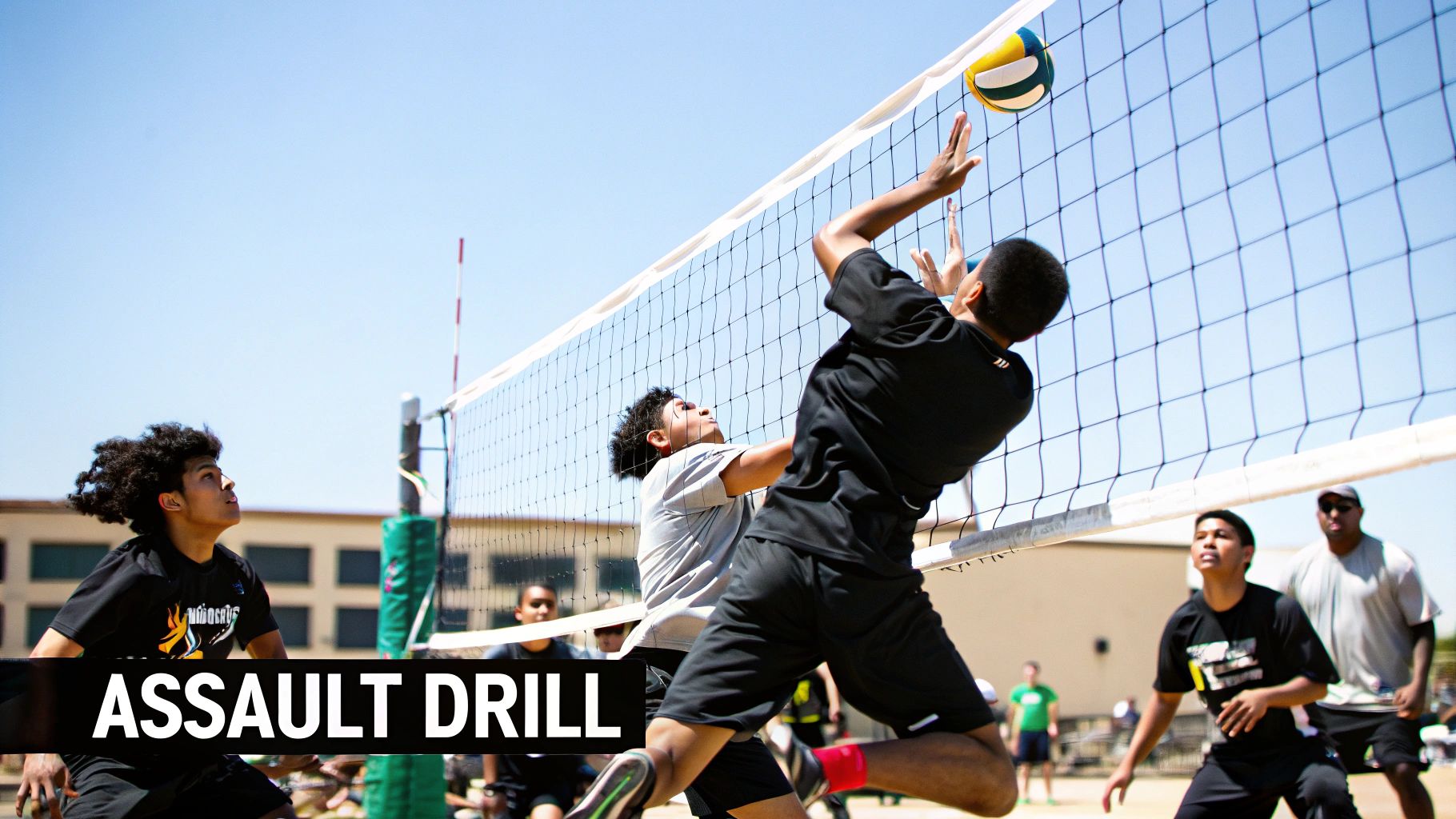
The Assault or Knockout game is a high-octane drill centred on rapid transitions between attack and defence. One team begins by attacking from near the service line, while the defending team starts at the net. The drill forces the defending team to absorb the attack, dig the ball, and immediately counter-attack in a single, fluid motion. This non-stop cycle makes it one of the most effective games for volleyball for developing explosive power and quick-twitch defensive reflexes.
This format is particularly brilliant for honing the transition phase of the game—a critical element in modern volleyball where points are often won or lost in the split seconds between defence and offence. Players learn to move from a defensive posture to an aggressive, attacking position almost instantaneously. This relentless pace builds both physical stamina and mental resilience, teaching athletes to stay focused and execute under fatigue.
Key Objectives and Benefits
Primary Focus: Transition play, defensive reaction speed, and counter-attacking.
Group Size: Best for 6+ players, allowing for a continuous rotation of attackers and defenders.
Why It Works: The game eliminates downtime and forces players into a constant state of readiness. It specifically trains the critical skill of turning a defensive play into an offensive opportunity, sharpening both physical reactions and strategic decision-making.
How to Implement the Assault/Knockout Game
Step-by-Step Rules:
One team (the "Defenders") starts in their defensive positions at the net.
A line of attacking teams (or pairs) forms behind the opposite service line. A coach or designated feeder tosses a ball to the first attacking team.
The attackers hit the ball over the net, and the defenders must dig, set, and counter-attack. The rally is played out.
If the defending team wins the point, the attackers are "knocked out" and go to the back of the line. The defenders stay, and the next attacking team steps up.
If the attacking team wins the point, they stay on, and the coach immediately feeds them another ball to continue their assault.
Set a goal for the attackers, such as scoring 3 points in a row to "win" the round and swap places with the defenders. The losing defenders are then "knocked out."
Coaching Insight: Focus on the quality of the first touch. An actionable insight is to reward a perfect dig-to-target with a "bonus point," even if the rally is lost. This reinforces that a controlled defensive touch is the foundation for every successful counter-attack.
Practical Tips for Success
Adjust Difficulty: For beginners, start with a coach-initiated toss that is easier to attack. For advanced players, make the feed more challenging to simulate difficult in-game situations.
Maintain Intensity: Keep the pace high by having the next team ready to go immediately. The goal is to create a game-like environment where there is no time to rest between points.
Provide Immediate Feedback: A coach positioned near the net can offer quick corrections on defensive posture, transition footwork, or shot selection during the counter-attack.
Film the Drill: Record short clips of successful sequences where teams transition smoothly from defence to offence. Use this footage as a powerful visual teaching tool to reinforce positive habits.
3. Four-Person Cooperative Rally Game
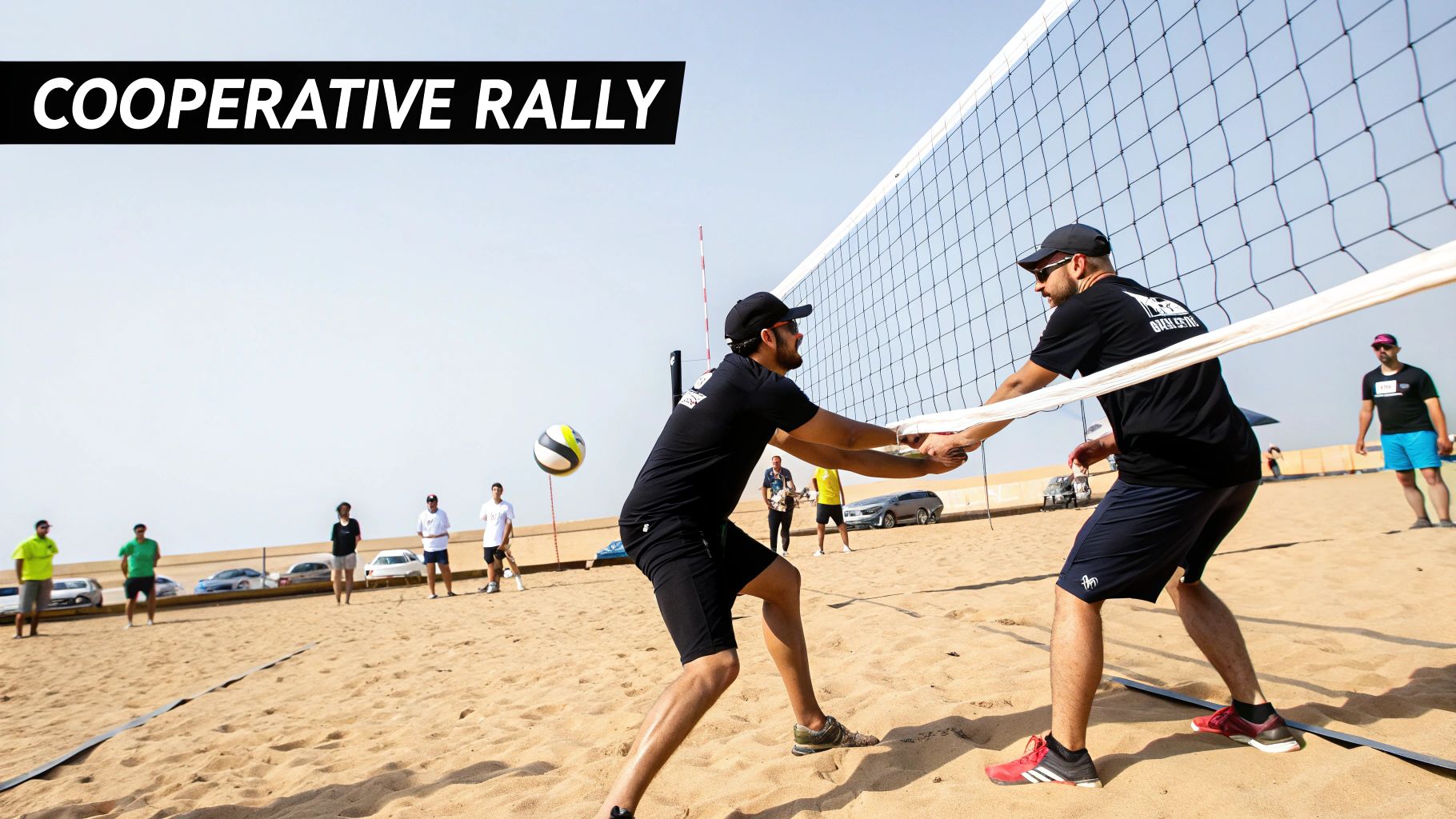
The Four-Person Cooperative Rally game shifts the focus from competition to collaboration, making it an exceptional tool for building team cohesion and foundational skills. In this format, two pairs of players work together on the same side of the court. Their opponent isn't another team, but rather a coach or a ball machine feeding consistent attacks. The collective goal is to sustain a rally for a predetermined number of successful contacts, emphasising control, communication, and mutual support over scoring points.
This game is particularly effective for developing court awareness and precise passing mechanics in a low-pressure environment. By removing the immediate win/loss outcome of each rally, players can concentrate on technique and teamwork. It fosters a positive, encouraging atmosphere, making it one of the most popular games for volleyball in settings like vacation camps, where social connection is as important as skill development.
Key Objectives and Benefits
Primary Focus: Communication, ball control, and team-building.
Group Size: Ideal for 4 players plus a coach or feeder. Can be adapted for larger groups by running multiple courts.
Why It Works: It encourages constant verbal and non-verbal communication between all four players. The shared objective builds trust and camaraderie, while the repetitive nature of the drill ingrains fundamentally sound passing and setting techniques.
How to Implement the Four-Person Cooperative Rally Game
Step-by-Step Rules:
Organise four players into two pairs on one side of the net.
A coach or another player stands on the opposite side, initiating a rally by sending over a controlled attack (a downball, a roll shot, or a light spike).
The group of four must successfully pass, set, and return the ball over the net to the feeder.
The feeder immediately sends another ball back, and the group works to keep the rally going.
The goal is to achieve a target number of consecutive successful returns (e.g., 10 in a row). If the ball drops, the count resets to zero.
Coaching Insight: Focus on positive reinforcement. An actionable tactic is to have players high-five between every single contact. This simple physical action builds kinesthetic connection and reinforces a team-first mindset, crucial for both indoor and beach volleyball tactics.
Practical Tips for Success
Gradual Progression: Start with an achievable target, such as 5 or 10 consecutive successful returns, and gradually increase the number as the group’s consistency improves.
Introduce Variations: Once the basic rally is mastered, add complexity. For example, require the third contact to be sent to a specific zone on the other side of the court.
Build Group Cohesion: Use this game early in a camp or training week. It's an excellent icebreaker that helps players learn each other's on-court tendencies and communication styles in a supportive setting.
Record and Review: Film a successful long rally and review it with the group. This provides powerful visual feedback and highlights moments of great communication and technical execution.
4. Around the World/Continuous Transition Game
Around the World is a high-energy, continuous drill focused on developing rapid transitions and all-around court awareness. Players cycle through a series of stations on and off the court, including serving, passing, setting, attacking, and defending. The ball is kept in constant play, forcing athletes to move efficiently and think ahead to their next role. This format is one of the most demanding games for volleyball and is brilliant for conditioning and improving a player’s court IQ.
This game excels at building the physical and mental stamina needed for long rallies and gruelling matches, particularly in beach volleyball where two players cover the entire court. It trains athletes to seamlessly switch from a defensive action to an offensive one, a critical skill in the modern game. This drill is a cornerstone in many European professional beach volleyball training programmes and is featured heavily in intensive camps for advanced players.
Key Objectives and Benefits
Primary Focus: Transition efficiency, conditioning, and role-specific skill execution under fatigue.
Group Size: Best for 6-12 players, allowing for multiple active stations.
Why It Works: It eliminates downtime and forces players to maintain high levels of concentration and physical output. The continuous rotation ensures every player practises every skill from various court positions.
How to Implement Around the World
Step-by-Step Rules:
Set up distinct stations around the court. A common setup includes a server, a passer, a setter, an attacker, and a defender. Extra players wait in a queue.
The coach (or a designated player) initiates the drill by feeding a ball to the passer.
The passer digs the ball to the setter, who sets the attacker.
The attacker hits the ball over the net, where the defender attempts to dig it.
After completing their action, each player immediately rotates to the next station in the sequence (e.g., passer becomes the setter, setter becomes the attacker, etc.). The last player in the sequence goes to the back of the queue.
The drill runs continuously for a set period (e.g., 5-10 minutes) before a break.
Coaching Insight: Focus on the quality of movement between stations. The actionable insight is to have players call out their next station ("Setter!") as they rotate. This verbal cue reinforces positional awareness and proactive thinking, key elements of high-level team tactics.
Practical Tips for Success
Use Visual Cues: Place cones or markers to clearly define each station and the rotation path. This helps players move instinctively and reduces confusion, especially when fatigued.
Scale the Complexity: Start with a simple 3 or 4-person rotation to master the flow before adding more stations and players. You can create zones with specific focuses, like a defensive station that only works on high-line digs.
Prioritise Form: Periodically pause the drill to provide technical feedback. High-repetition drills can ingrain bad habits if form breaks down due to fatigue, so active coaching is essential.
Manage Workload: This is a high-intensity game. Ensure you schedule adequate hydration breaks and rest intervals to prevent overexertion and maintain a high quality of play.
5. Modified Mini-Games (2v2 and 3v3 Formats)
Modified mini-games using 2v2 or 3v3 formats on reduced court sizes are fundamental for rapid skill development, especially in beach volleyball. The core idea is to increase the number of ball contacts per player, forcing quicker decision-making and better communication in a smaller space. These formats are a cornerstone of many development programmes because they accelerate learning by maximising individual participation and court coverage responsibilities.
This approach is highly adaptable, allowing coaches to tweak rules to isolate specific skills. For example, a beach volleyball game might ban setting to focus purely on bump-set control or introduce a "three-touch mandatory" rule to encourage teamwork and patience. These focused, high-repetition scenarios make them one of the most efficient games for volleyball for building a strong technical foundation before scaling up to full-court play.
Key Objectives and Benefits
Primary Focus: Individual ball control, communication, and court awareness.
Group Size: Ideal for 4-12 players, organised into teams of 2v2 or 3v3.
Why It Works: With fewer players, each individual is forced to touch the ball more often and cover more ground. This high-involvement environment quickly improves passing, defence, and shot selection, building a player's confidence and competence.
How to Implement Modified Mini-Games
Step-by-Step Rules:
Set up a smaller court. A standard beach court can often be divided into two or three mini-courts using lines or cones. For more detail, you can explore the standard beach volleyball court dimensions to guide your setup.
Divide players into teams of two or three. Have any extra teams wait on the sideline to rotate in after a set number of points or time.
Initiate play with a serve or a coach-initiated "free ball" toss.
Play out the rally according to standard rules or introduce specific modifications (e.g., only underhand passing, no spiking allowed, etc.).
Run games to a specific score (e.g., first to 11) or for a set time (e.g., 5-minute rounds) before rotating teams.
Coaching Insight: Use mini-games to diagnose individual weaknesses. The high number of touches per player makes it easy to spot and correct technical flaws. Actionable insight: require a player to call out their intended shot ("Line!" "Cross!") before the third contact to build strategic intentionality.
Practical Tips for Success
Goal-Oriented Rules: Tailor the rules to your session's goal. If the focus is on defence, award bonus points for a successful dig. If it's communication, require players to call the ball on every touch.
Gradual Progression: Start with a very small court to build control and confidence, then gradually expand the playing area as players' skills improve. This progressive overload keeps the challenge appropriate.
Rotate Partners: In 2v2 formats, frequently switch partners. This forces players to adapt their communication and play style to different teammates, a crucial skill in team sports.
6. Target-Based Scoring Games (Zones and Targets)
Target-Based Scoring adds a layer of precision and strategy to standard drills by assigning specific zones on the court that yield bonus points. Instead of just winning a rally, players are rewarded for how they win it. This could mean a serve landing deep in a corner, a shot hit to a specific spot, or an attack that forces the opponent out of position. These are highly effective games for volleyball for developing accuracy and court vision.
This approach transforms repetitive drills into engaging challenges, forcing players to think critically about shot selection rather than just hitting the ball over the net. It directly connects a technical action with a strategic outcome, teaching players to identify and exploit open areas of the court. This is crucial for moving from intermediate to advanced play, where point-scoring often depends on precision over pure power.
Key Objectives and Benefits
Primary Focus: Accuracy, court awareness, and strategic shot selection.
Group Size: Adaptable for any size, from individual serving practice to full 6v6 gameplay.
Why It Works: It provides immediate, measurable feedback on a player's execution. By gamifying accuracy, it makes the deliberate practice of hitting specific spots more enjoyable and motivates players to refine their control.
How to Implement Target-Based Scoring
Step-by-Step Rules:
Define the target zones on the court using cones, ropes, or tape. For example, mark out the deep corners or a "donut" in the middle of the defence.
Assign point values. A standard rally win might be one point, but hitting a designated target zone on a winning attack could be worth three points.
Initiate a game, such as a regular rally or a wash drill, with the new scoring rules in effect.
Play to a target score (e.g., first team to 21 points) or for a set amount of time.
The team or player with the highest score at the end wins.
Coaching Insight: Start with larger, more forgiving target zones and gradually make them smaller as player accuracy improves. An actionable tip is to tie the targets to specific offensive plays, e.g., "Score 3 points by hitting Zone 5 to 'unlock' the ability to hit line." This gamifies tactical decision-making.
Practical Tips for Success
Integrate with Skills: Apply target scoring to specific skills. For serving, reward aces in Zones 1 and 5. For attacking, reward a kill down the line. For attackers aiming to improve their power, you can find helpful advice on how to get a higher vertical jump to create better angles.
Rotate Targets: Change the location of the bonus zones frequently to keep opponents guessing and force players to adapt their strategy, simulating a real match scenario.
Team Competitions: Split the squad into two teams and run a full game where certain shots (e.g., a "pipe" attack that scores) are worth bonus points. This encourages tactical team play and communication.
7. Challenge/Complaint Game (Rule-Based Competition)
The Challenge Game transforms a standard scrimmage into a powerful learning tool by introducing a formal, rule-based structure where players can challenge calls. This format isn't just about playing; it's about understanding the nuances of the game's regulations. Players must learn to identify incorrect calls, articulate their reasoning clearly, and advocate for themselves respectfully, creating a realistic simulation of high-stakes tournament conditions. This is one of the most effective games for volleyball for developing mentally tough, rules-literate athletes.
From a sports psychology perspective, this game is invaluable. It teaches athletes to manage their emotions during disputed points and communicate effectively with officials, a crucial but often overlooked skill. By integrating rule discussions directly into gameplay, it moves beyond rote practice and develops smarter, more strategic players who understand the "why" behind every whistle.
Key Objectives and Benefits
Primary Focus: Rules comprehension, communication with officials, and emotional regulation.
Group Size: Ideal for 12+ players to have full teams and a designated (rotating) officiating crew.
Why It Works: It directly addresses the pressure of disputed calls in a controlled environment. Players don't just learn the rules; they learn how to apply them under pressure, turning potential frustrations into teachable moments and strategic advantages.
How to Implement the Challenge Game
Step-by-Step Rules:
Divide players into two teams to play a regular match. Designate one or more players to act as referees (first referee, second referee, line judges).
Before starting, establish a clear procedure for challenges. For example, the team captain must signal the challenge immediately after the rally ends.
When a call is challenged, the refereeing player must explain their decision. The challenging team then presents their case, citing the specific rule they believe was misapplied.
The coach acts as the final arbiter, using the moment to explain the correct rule application to everyone.
Establish a consequence system. A successful challenge might result in the point being replayed or awarded to the challenging team. An unsuccessful challenge could result in losing a point or a future challenge.
Rotate officiating duties so every player experiences the game from a referee's perspective.
Coaching Insight: Use an official rulebook, like the FIVB Official Beach Volleyball Rules, as the ultimate guide. An actionable tip is to have the challenging player physically point to the rule in the book. This reinforces learning and removes ambiguity.
Practical Tips for Success
Focus on Communication: Coach players on how to challenge—calmly and respectfully. Role-play scenarios to practise articulating their point without becoming overly emotional or aggressive.
Track Challenge Stats: Keep a record of successful vs. unsuccessful challenges for each team or player. This adds a competitive element and helps you identify which rules your team struggles with most.
Use as a Tournament Prep Tool: Implement this game in the weeks leading up to a major competition. It’s an invaluable way to prepare players for the mental rigours of sanctioned play and ensure they are ready for any officiating scenario.
8. Skill-Station Relay Games (Rotational Drill Competitions)
Skill-Station Relay Games transform a standard practice into an engaging and comprehensive circuit-training competition. This format involves setting up multiple stations, each dedicated to a specific volleyball skill like passing, setting, serving, or defence. Teams rotate through these stations, completing challenges or repetitions to earn points based on speed, accuracy, or quality.
This approach is one of the most versatile games for volleyball, as it allows coaches to address numerous technical areas within a single session. By breaking down complex gameplay into focused, manageable tasks, it helps players refine individual skills in a low-pressure yet competitive environment. This method is particularly popular in junior development programmes and mixed-skill camps, where individualised attention and varied activities are key to maintaining engagement.
Key Objectives and Benefits
Primary Focus: Comprehensive skill development, technical repetition, and team engagement.
Group Size: Excellent for 8+ players, organised into small teams of 2-4.
Why It Works: It ensures every player receives targeted practice on a wide range of skills, preventing the monotony of single-drill sessions. The relay format introduces a competitive element that motivates players to perform each repetition with purpose and precision.
How to Implement Skill-Station Relay Games
Step-by-Step Rules:
Set up 4-6 distinct stations around the court or training area. Each station should have a clear objective (e.g., "Serve 10 balls into Zone 5," "Complete 20 controlled passes to a target," "Perform 15 defensive digs").
Divide players into small, balanced teams. Assign each team to a starting station.
Set a timer for each station rotation (e.g., 5-7 minutes).
On "Go," teams begin their station's task. They accumulate points based on successful repetitions or the time taken to complete the challenge.
When the timer ends, teams tally their points for that station and rotate to the next one in a predetermined sequence.
After all teams have completed every station, the total points are tallied to declare an overall winner.
Coaching Insight: Create clear instruction cards for each station with diagrams and scoring rules. This empowers players to manage their own station. The actionable insight is to include a "bonus challenge" on each card (e.g., "perform 5 reps with your non-dominant hand") for teams that finish early, maximizing engagement and skill-building.
Practical Tips for Success
Logical Progression: Design the circuit so that skills build upon each other. For instance, a passing station could be followed by a setting station, and then a hitting station.
Adapt Difficulty: Offer different difficulty levels at each station to accommodate mixed abilities. A serving station might have a larger target for beginners and a smaller one for advanced players.
Monitor and Motivate: Use assistant coaches or senior players as station monitors to ensure proper technique and keep the energy high.
Integrate into Schedules: This format works exceptionally well as a warm-up to a larger practice or as a full session in itself. To discover how different camps structure their training, you can explore various programmes through a detailed look at camps for volleyball around the world.
Comparison of 8 Volleyball Games
| Game | Implementation Complexity | Resource Requirements | Expected Outcomes | Ideal Use Cases | Key Advantages | Limitations |
|---|---|---|---|---|---|---|
| King of the Court (Competitive Rotation Games) | Moderate — manage rotations and leaderboard | One court per rotation group, scoreboard/leaderboard, minimal coaching | Improved competitive mentality, pressure handling, quick decisions | Intermediate/advanced camps, tournament preparation, conditioning | High engagement, continuous play, scalable across levels | Can intimidate beginners; limited focused coaching; winning teams fatigue |
| Assault/Knockout Game | Moderate–High — elimination flow and rapid rotations | Net, coach at net, ample players, good conditioning | Explosive attacking, fast defensive reactions, transition skills | Advanced clinics, high-performance training, pace-focused sessions | Rapid skill gains, realistic match pace, easy difficulty scaling | Very physically demanding; injury/fatigue risk; less suitable for novices |
| Four-Person Cooperative Rally Game | Low — simple cooperative setup with feeder | Coach or ball machine feeder, small groups, minimal gear | Consistent passing, communication, court awareness | Beginner/vacation camps, mixed-skill groups, confidence-building | Supportive environment, high repetitions, low injury risk | Limited competition simulation; needs dedicated feeder; can be repetitive |
| Around the World/Continuous Transition Game | Moderate — clear rotation markers and flow control | Cones/markers, multiple players, space for continuous play | Transition efficiency, endurance, positioning and adaptability | Intermediate/advanced, fitness-focused and transition training | Builds court awareness and endurance; high engagement | High physical demand; confusing for beginners; less technical coaching time |
| Modified Mini-Games (2v2 and 3v3 Formats) | Low — simple rule and court size changes | Reduced court space, basic equipment, flexible player numbers | Increased touches per player, foundational skills, communication | Beginner camps, foundational skill development, limited-space sessions | Maximizes individual touches, adaptable rules, easy to run | Different spatial demands vs full court; may not train full-court serving |
| Target-Based Scoring Games (Zones and Targets) | Moderate — set up zones and scoring rules | Markers/cones/chalk, time for layout, optional video tools | Improved accuracy, shot selection, strategic court thinking | Skill-development clinics, technical training, precision work | Measurable progress, strategic focus, engaging objectives | Setup time; can distract mechanics if overemphasized; may frustrate players |
| Challenge/Complaint Game (Rule-Based Competition) | Moderate–High — requires referee and challenge process | Knowledgeable referee/coach, time for disputes, rules materials | Rules literacy, assertiveness, match-like decision-making | Tournament prep, advanced camps, officiating education | Realistic match simulation, teaches advocacy and sportsmanship | Slows gameplay; needs rule-savvy participants; potential for contention |
| Skill-Station Relay Games (Rotational Drill Competitions) | High — coordinate multiple stations and scoring | Multiple coaches/assistants, varied equipment, ample space | Broad technical development, measurable station metrics | Mixed-ability camps, vacation-style programs, comprehensive training | Efficient multi-skill coverage, adjustable difficulty, high engagement | Significant setup and staffing; can feel disjointed; may mask individual needs |
Integrating Purposeful Play into Your Training Programme
Moving beyond traditional drills and embracing a game-based approach is the catalyst that transforms good teams into great ones. Throughout this guide, we have explored a diverse collection of games for volleyball, from the high-intensity pressure of "King of the Court" to the focused precision of "Target-Based Scoring". Each game serves as more than just a fun alternative; it is a powerful tool for developing specific skills, forging team cohesion, and replicating the unpredictable, high-stakes environment of a real match. The true art lies not in simply knowing these games, but in understanding how to integrate them purposefully into your training fabric. A well-structured session should feel less like a checklist of drills and more like a carefully orchestrated sequence of challenges that build upon one another, addressing technical weaknesses, tactical naivety, and psychological resilience in a holistic manner.
The core takeaway is that purposeful play accelerates learning. Repetition without context can lead to burnout and robotic execution. By embedding skill development within the framework of a game, you create an environment where athletes are forced to make decisions, communicate under pressure, and adapt their technique in real-time. This is where genuine athletic intelligence is cultivated. The "Challenge/Complaint Game" is not just about serving; it is a lesson in mental fortitude and strategic rule exploitation. Similarly, "Around the World" is more than a transition drill; it is a physical and mental test of endurance and consistent execution when fatigued. By framing training in this way, you tap into the competitive spirit that drives athletes, making every touch on the ball meaningful and every session a step towards peak performance.
From Knowledge to Action: Your Next Steps
To effectively implement these games for volleyball, your first action should be a candid assessment of your team's or your own individual needs. Avoid the temptation to just pick the most "fun" looking game. Instead, ask critical questions:
Technical Deficiencies: Are we struggling with first-ball side-out? Is our block-defence system disorganised? Select games like "Assault/Knockout" or "Modified Mini-Games" to create high-repetition scenarios that target these specific areas.
Tactical Awareness: Do players struggle with court vision or anticipating an opponent's attack? For beach volleyball teams, do you have a consistent strategy for defending angles versus line? Games that demand strategic thinking, like "King of the Court" with specific scoring conditions, can sharpen these tactical instincts.
Psychological Weaknesses: Does the team crumble under pressure or lose focus after a series of errors? Introducing games that have high stakes, like a point-per-rally scoring system, helps build the mental toughness required to thrive in critical match moments. For further reading, resources like the Association for Applied Sport Psychology offer excellent insights into building resilience.
Once you have identified your priorities, begin mapping out your training sessions. A balanced programme should feature a mix of cooperative games for warm-ups (like the "Four-Person Cooperative Rally"), skill-specific competitive games for the core of the session, and high-energy, team-wide games to finish on a positive and competitive note. Remember to constantly adapt the rules, court size, and scoring systems to keep the challenges fresh and aligned with your evolving goals. This strategic application of games for volleyball is what separates standard practice from truly transformational training.
Ready to experience how the world's best coaches integrate purposeful play into their training? Explore the wide range of volleyball and beach volleyball camps on MyNextCamp, where you can find specialised programmes focused on tactical development and competitive gameplay. Find the perfect camp to elevate your skills and passion for the game at MyNextCamp.
47 views
Find Your Next Camp
Compare beach volleyball camps across Europe. Filter by country, dates, and price.