
Your Ultimate Guide to Beach Volleyball in Spain
•MyNextCamp Team
Discover the best beach volleyball in Spain. This guide reveals top hotspots, pro team tactics, mental strategies, and how to find the perfect training camp.
Picture this: you’re stepping onto warm sand under a brilliant blue sky, ready for a day of serves, digs, and spikes. This isn't a once-a-year holiday fantasy; for many, it’s the everyday reality of beach volleyball in Spain. With its endless coastline, year-round sun in key spots, and a sports culture that runs deep, Spain has cemented its place as Europe's go-to destination for players of every stripe.
Why Spain Is a Paradise for Beach Volleyball Players
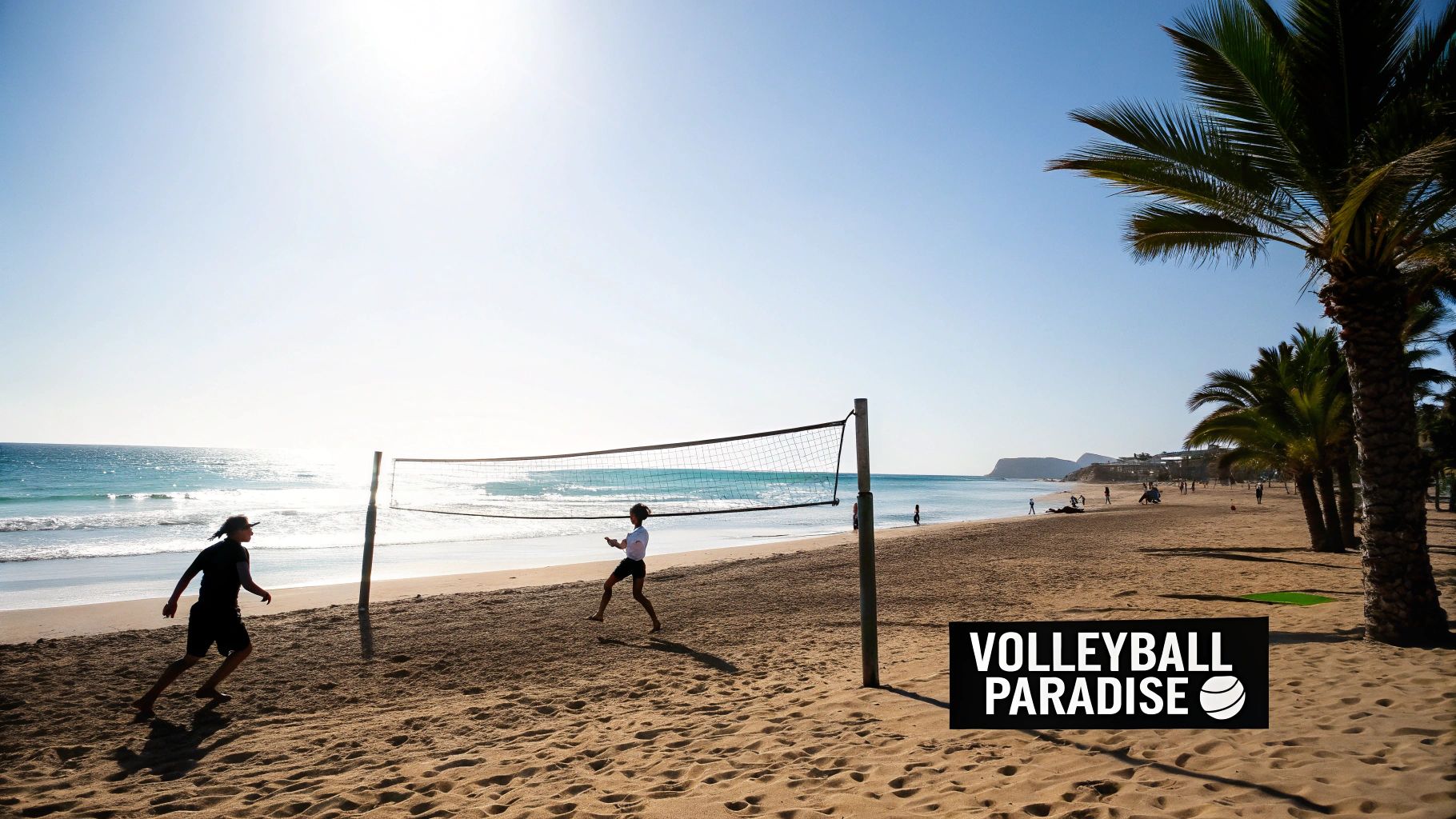
What makes Spain so special? It's that unique blend of ideal weather, top-notch facilities, and a community that genuinely lives and breathes the sport. While much of Europe packs up its nets when summer ends, places like the Canary Islands offer a perfect training ground even in the dead of winter. This reliable climate is a magnet, drawing a global crowd of players, coaches, and fans all year long.
This constant flow of talent means you're not just playing in a beautiful location—you're dropping right into a high-level volleyball environment. Whether you're a total beginner learning the basics or a pro fine-tuning your game, the infrastructure is here to help you get it done.
The Perfect Blend of Training and Holiday
One of the biggest draws is how seamlessly Spain merges serious training with a proper holiday vibe. You can spend your mornings grinding through intensive drills on team tactics, then switch off completely in the afternoon—exploring local culture, kicking back on the beach, or diving into some incredible Spanish food. This balance is crucial for avoiding burnout and fostering a healthy sports psychology, making skill development feel less like a chore and more like a passion project.
For so many players, the mental game is just as critical as the physical one. Spain's whole atmosphere lets you disconnect from the daily grind and just focus on your game. It creates a space where you can truly "feel yourself on the court."
This approach doesn't just improve your game; it recharges your batteries. It's a chance to grow as a player while making memories that will stick with you long after you've shaken the last of the sand from your bags.
A Thriving Community and Coaching Scene
The boom in beach volleyball has cultivated a rich ecosystem of coaches and players across Spain. You can find camps run by former pros and world-class instructors who bring a ton of strategic knowledge to the sand. The community is famously welcoming, too, making it easy for solo travellers to find a partner or for teams to find a competitive match.
This supportive network is a huge part of the experience, offering:
- Skill-Matched Groups: Camps are great at sorting players by ability, so you’re always challenged but never totally out of your depth.
- Networking Opportunities: You'll connect with players from all over the world, building friendships and future training partnerships.
- Diverse Coaching Philosophies: Get exposed to different coaching styles and find an approach that really clicks with how you learn.
Ultimately, playing volleyball in Spain is more than just a trip. It’s an investment in your skills and your well-being. To see what's out there, you can explore a massive variety of beach volleyball camps in Spain designed for every level and ambition.
Where to Play: Spain's Top Beach Volleyball Hotspots
Not all Spanish beaches are created equal, especially when it comes to world-class beach volleyball. Finding the right spot really depends on what you're looking for, the time of year you want to go, and the kind of atmosphere you thrive in.
Think of Spain’s coastline as a strategic map for players. Some areas are built for intense, year-round training, while others explode with a more relaxed, social vibe during the summer months. Pinpointing the perfect region is your first step to an unforgettable volleyball trip to Spain.
The Canary Islands: The Year-Round Haven
When professional players and dedicated amateurs need to train through the winter, they all head to the Canary Islands. Islands like Tenerife and Gran Canaria are the undisputed champions of year-round beach volleyball, and it’s all thanks to a climate that feels like a perpetual spring. The average temperature rarely dips below 20°C, even in the middle of January.
Because the weather is so consistent, the infrastructure is permanent and the community is always buzzing. You can find top-notch courts and organised training sessions any month of the year. This makes it the go-to destination for players wanting to escape a cold European winter without missing a beat in their training. The vibe here is focused and international; don't be surprised to find yourself sharing the court with serious athletes from all over the world.
- Best Season: October to April (but honestly, it's great all year).
- Community Vibe: International, dedicated, and training-focused.
- Perfect For: Players who need consistent, high-level training, especially during the off-season.
If you want to dive deeper into this region, you can learn more about what makes the Canary Islands a top volleyball destination in our guide.
Andalusia: The Passionate Summer Hub
Come summer, the southern coast of Andalusia completely comes alive. Places like Málaga and Cádiz transform into buzzing hotspots where the local passion for beach volleyball is impossible to ignore. The scene here is vibrant and incredibly social, blending competitive play with that classic Spanish summer holiday feeling.
The season is much more defined than in the Canaries, really hitting its peak from May to September. During these months, the beaches are packed with players of all levels, local tournaments pop up constantly, and the community spirit is fantastic. It's the perfect choice if you want to soak up Spanish culture, enjoy long sunny days, and meet local players who live and breathe the sport.
The energy in Andalusia is infectious. It’s less about escaping the winter and more about embracing the peak of summer, where the love for the game is matched by a love for sunshine and social connection.
Catalonia: The Urban Volleyball Scene
For anyone who craves a mix of big-city life and beach culture, Catalonia is the answer. Barcelona and its nearby coastal town, Sitges, offer a unique setup where you can train on the beach in the morning and explore a world-class city in the afternoon. The infrastructure is excellent, with tons of public courts and private clubs lining the coast.
The community in Catalonia is a dynamic mix of locals, expats, and tourists, which creates a really diverse and energetic playing environment. The main season runs from late spring to early autumn, right in line with the Mediterranean climate. This region is ideal for players who want a balanced trip—one that combines serious court time with cultural exploration, incredible food, and urban excitement. You really get the best of both worlds here.
Spain's Beach Volleyball Hotspots At-a-Glance
Feeling a bit stuck on which Spanish coast to choose? This quick comparison should help you decide which destination fits your season, vibe, and player profile.
| Region | Best Season to Play | Community Vibe | Perfect For |
|---|---|---|---|
| Canary Islands | October - April | International & Training-Focused | Serious players needing year-round, high-level training. |
| Andalusia | May - September | Social, Passionate & Local | Players wanting a summer buzz, local culture, and fun tournaments. |
| Catalonia | April - October | Urban, Diverse & Energetic | Those who want to mix quality training with city exploration. |
Each spot offers something special. The Canaries are for the dedicated athlete, Andalusia is for the social summer player, and Catalonia is for the explorer who wants it all. No matter which you pick, you're in for some incredible beach volleyball.
Unlocking Advanced Beach Volleyball Team Tactics
So, you've found the perfect stretch of sand for some volleyball in Spain. The rallies are fun, but you're ready to move beyond just getting the ball over the net. You're ready to start thinking like a competitive beach volleyball team.
Advanced beach volleyball isn't about raw power; it's a strategic dance between two partners. It’s built on clever offence, synchronised defence, and communication that feels almost telepathic. Mastering these elements is what turns a simple back-and-forth into a chess match on the sand.
Ready to level up? Let's break down the playbook for high-level 2v2 strategy, starting with a smarter, more dynamic attack.
Spain’s diverse coastlines offer the perfect backdrop to practise these skills. From the Canary Islands to Andalusia, there's a court waiting for you.
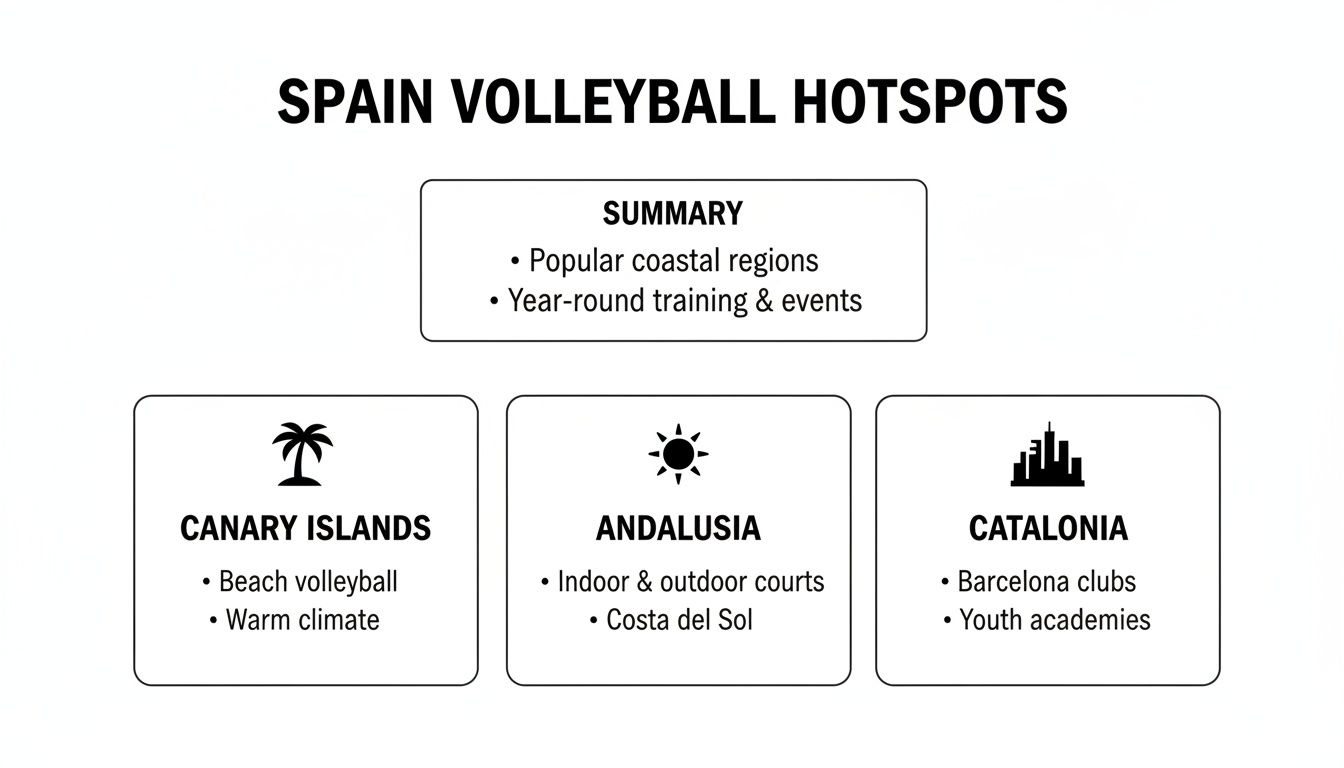
As you can see, the Canary Islands are perfect for year-round training, while Andalusia and Catalonia offer vibrant seasonal scenes to put your new tactics to the test.
Crafting a Sophisticated Offensive Game
Elite offence is all about creating and exploiting opportunities. It means moving beyond the obvious power spike and into a world of shots designed to keep the defence completely off-balance. The real goal is to make every attack unpredictable.
Think of your offensive toolkit like this:
- The Power Hit: This is your bread and butter. Aim it deep into the corners or straight down the line to force the defence back on their heels.
- The Cut Shot: A sharp, angled hit across the court. It’s absolutely devastating against a defender who cheats towards the line or a blocker who is just a fraction too slow.
- The Poke or "Jumbo": This is the finesse shot. A soft, high-arching touch placed just over the blocker's hands, dropping into that undefended space right behind them. It’s the perfect punishment for teams that play too deep.
- The Option Play: Pure surprise. This is when the setter attacks on the second touch. It catches opponents completely off guard, especially when they’re expecting the standard set-and-hit sequence.
Actionable Insight: The art is knowing when to use each shot. Before your partner serves, quickly scan the opponents. Is the defender already deep in the court? The poke shot is your best friend. Is the blocker slow to move laterally? Plan to use the cut shot. Reading the defence before the point starts is the key that unlocks your entire offensive arsenal.
Defensive Synchronicity: The Blocker-Defender Dance
In 2v2 beach volleyball, defence is a partnership in its purest form. The blocker and defender have one job: work together to "shrink the court" for the attacker, making it feel like there are no open spaces to hit.
This coordination starts before the ball is even served. The blocker uses hand signals behind their back to silently communicate the defensive plan. For reliable guidance on signals and strategies, a great resource is the FIVB's official coaching materials. A "one" signal (one finger) might mean they're blocking the line shot, forcing the attacker to hit cross-court where the defender is already waiting. A "two" signal (two fingers) could mean they're taking away the angle, leaving the line shot for the defender to cover.
"I feel myself on the court. And sometimes I don’t feel myself outside, so when I play, I want to transmit what I feel and what I really am."
This sentiment from pro player Valentina Gottardi perfectly captures that on-court synergy. You have to feel connected to your partner's intentions. When the blocker commits to a call, the defender has to trust it and position themselves to cover the rest of the court. It’s a constant, split-second conversation of action and reaction.
The Secret Sauce: Unbreakable Communication
While hand signals set the defensive stage, it's the constant verbal and non-verbal chat that holds a team together through every single point. This is where the mental game truly comes alive.
Great teams are never silent. They are constantly talking, feeding each other information, and offering encouragement.
Essential verbal calls you'll hear on every court include:
- "Mine!" or "Yours!": Loud, clear, and early. This simple call eliminates hesitation and confusion.
- "Line" or "Angle": A defender shouting where the open shot is for their attacking partner to aim for.
- "Watch the short!" or "Deep!": Alerting your partner to where the opponent is likely to place their shot.
Beyond the words, body language is huge. A simple nod, a thumbs-up after a tough rally, or just making eye contact before a serve builds trust and resilience. This is the psychological bond that helps you reset after an error and stay locked-in during a tight final set. It's this connection that allows two individuals to move as one cohesive, winning unit.
Mastering the Mental Game of Beach Volleyball
Tactics and physical fitness will get you far in volleyball in Spain, but they only tell half the story. The real difference between a good player and a great one is often what happens between the ears.
Beach volleyball is a game of constant pressure, lightning-fast momentum swings, and intense partner dynamics. This makes sports psychology less of a "nice-to-have" and more of a critical part of your toolkit. For deeper dives, platforms like BelievePerform offer valuable articles on the mental side of the game.
The mental game isn't some fuzzy concept; it's a set of real skills you can train, just like your serve or your defence. It's about building the resilience to bounce back from a shanked pass, staying focused when a tight match gets pushed to a third set, and creating an unbreakable bond with your partner. These are the skills that keep you steady and playing your best when the pressure is on.
Building Your Mental Armour
Mental toughness really starts with how you react to things on the court. An error is just one point, but the story you tell yourself about that error can completely derail your match. The trick is to develop a system for acknowledging the mistake, learning from it, and instantly resetting your focus for the very next play.
Actionable Insight: One of the most powerful ways to do this is with a pre-serve routine. This is a simple, consistent sequence of actions—taking a deep breath, bouncing the ball twice, making eye contact with your partner—that you do before every single serve. This little ritual acts as a mental anchor, pulling your focus back to the present moment and away from past mistakes or future worries.
The Power of Positive Self-Talk
The conversation you have with yourself on the court has a direct impact on your confidence and performance. Negative self-talk like, "I can't pass today," or, "We're going to lose," creates a self-fulfilling prophecy. It ratchets up the tension and makes mistakes far more likely. On the flip side, constructive self-talk can be a huge performance booster.
The key is to move beyond generic positivity and use specific cues.
- Instructional Self-Talk: This is about technique. Think simple phrases like "Hands high," "Step to the ball," or "See the whole court." It keeps your mind focused on the task, not the outcome.
- Motivational Self-Talk: This is for building confidence and effort. "Let's go," "Stay aggressive," or "We've got this point."
This focus on the internal experience is what separates elite athletes. They understand that controlling their mind is the first step to controlling the game. It's about finding that state where, as pro player Valentina Gottardi says, "I feel myself on the court."
By consciously choosing your internal script, you can reframe challenges, hold onto belief in your own skills, and grind through the toughest moments in a match.
Forging an Unbreakable Partner Connection
In a 2v2 game, your biggest psychological advantage is your partner. The connection you build has a direct line to how well you handle tough times on the court. A strong partnership is built on trust, clear communication, and unwavering support, especially when things aren't going your way.
Actionable Insight: A simple but incredibly effective rule is the "next point" mentality. After a mistake happens, the focus immediately shifts to supporting your partner and getting ready for the next rally. There's no time or space for blame or visible frustration. A quick word of encouragement or a high-five can instantly reset the team's energy and reinforce that you're in it together.
You can also try using visualization as a team. Before a big tournament, take a few minutes together to picture successful plays, smooth communication, and working your way out of tough spots. This shared mental practice prepares you to react as a single unit when the pressure is real. By building this mental synergy, you stop being two individuals and become one resilient team.
For more ideas on building team cohesion, check out our guide on fun and effective games for volleyball that strengthen teamwork.
How to Choose the Perfect Spanish Beach Volleyball Camp
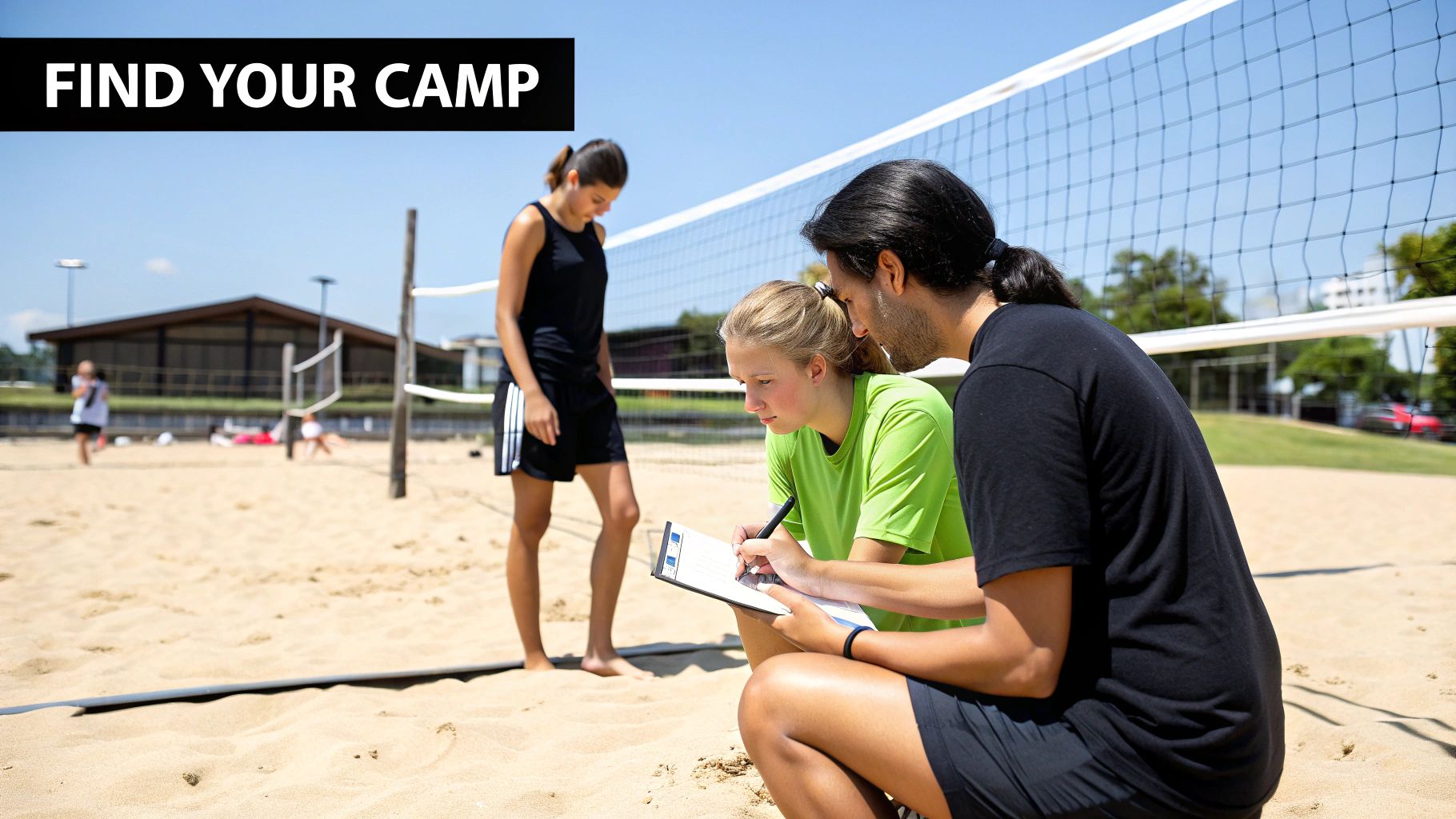
Picking the right volleyball camp in Spain can feel a bit like a tough rally—so many options, so much to think about. But if you break it down, the whole process gets a lot simpler. The right camp won't just sharpen your skills; it'll introduce you to lifelong friends and strike that perfect balance between serious training and a much-needed holiday.
First things first: what are you really after? Are you hunting for an intense, technique-heavy clinic to get you ready for competition? Or is this more of a "volley-cation," where the beach bars and social scene are just as important as the drills? Both types of camps are everywhere in Spain, but they deliver completely different experiences. Getting honest about your main goal is the first step to finding your perfect match.
Know Your Camp Type
Not all camps are created equal. Figuring out which category fits your vibe will help you narrow down the search right from the start.
- Intensive Training Clinics: These are for the serious player. Think multiple sessions a day, deep dives into strategy, video analysis, and a heavy focus on competitive play. The main objective here is to get better, fast.
- Volley-Cations: These camps are all about balance. You’ll usually have one training session a day, which leaves plenty of time to explore the town, chill on the beach, and just soak up the Spanish sun. They’re brilliant for players who want to improve without the pressure of a high-performance setting.
- Skill-Specific Workshops: Some camps go deep on one part of the game. You might find a weekend dedicated entirely to setting or a masterclass on defensive strategy. These are perfect if you're looking to turn a specific weakness into a strength.
Once you’ve got a handle on the kind of experience you want, it's time to get into the nitty-gritty of the coaching and the group you’ll be playing with.
Key Questions to Ask Before Booking
The difference between a good camp and a great one is often in the details. Before you click "book," make sure you have clear answers to a few crucial questions. The quality of the coaching and the dynamic of your group will make or break your trip.
"I feel myself on the court... when I play, I want to transmit what I feel and what I really am." - Valentina Gottardi, Professional Player
This quote gets to the heart of what a great camp should feel like—a place where you're comfortable enough to be yourself and really get in the zone. To make sure you find that, ask the camp organiser a few things:
- What is the coach-to-player ratio? A smaller ratio, something like 1 coach for every 6-8 players, means you’re going to get a lot more personal feedback. Bigger groups can be a blast, but you might get less one-on-one attention.
- What’s the coaching philosophy? Do they focus on drilling fundamentals into you, or is it more about tactical gameplay? Or a mix of both? Make sure their approach lines up with how you actually like to learn.
- How do you split the groups by skill level? You want to be pushed, but not completely out of your depth. Ask how they assess players to ensure you’ll be training with people at a similar level.
- What’s actually included in the price? Always check if the fee covers things like your accommodation, meals, airport transfers, or any extra activities. A camp that looks cheaper at first might end up costing more if you have to sort all that out yourself.
This is where platforms built for finding sports camps come in handy. For example, using the search filters on MyNextCamp lets you compare your options based on these exact criteria, taking a lot of the guesswork out of the process. You can spend less time digging for information and more time getting excited for your perfect volleyball in Spain getaway.
Planning Your Volleyball Trip to Spain FAQ
You've got the inspiration, you know where to go, and you’re armed with some next-level tactics. Now for the practical stuff. Any trip comes with questions, and a focused volleyball trip to Spain is no different.
Let's get into the nitty-gritty. This section tackles the most common questions head-on, from what to budget for a week of training to exactly what to stuff in your bag. Think of this as your pre-flight checklist to make sure you land in Spain ready to play.
What Does a Week-Long Beach Volleyball Camp in Spain Typically Cost?
The price tag on a Spanish beach volleyball camp can swing quite a bit, so it pays to know what you’re looking at. The final cost usually boils down to the location, the calibre of the coaches, and what’s bundled into the package.
If you just want the training and prefer to handle your own food and accommodation, a training-only camp is a great starting point. Expect to pay somewhere in the range of €300 to €450 for a week.
But the all-inclusive packages are where most people land, typically running from €650 to over €1,300. These deals usually wrap up your coaching, a place to stay (often a shared apartment with other players), and sometimes meals. Naturally, high-performance camps run by professional or elite-level coaches will sit at the top end of that scale. Always read the fine print to see exactly what’s included before you book.
Can I Go to a Camp if I Do Not Have a Partner?
Absolutely. In fact, most camps in Spain are built for solo travellers. It's hands-down one of the best ways to plug yourself into the international volleyball community. Organisers are pros at creating a vibe that's both social and inclusive from day one.
When you get there, they’ll group you with players at a similar skill level for all the drills and games. This keeps things challenging without being overwhelming. Showing up alone is a golden opportunity to make new friends and maybe even find a playing partner for future tournaments. Many camps even offer accommodation designed for individuals, like a spot in a shared apartment.
"I feel myself on the court... when I play, I want to transmit what I feel and what I really am." - Valentina Gottardi, Professional Player
This is exactly the feeling a great camp fosters—a place where you can be yourself and connect with the game, whether you came with a partner or not.
What Specific Gear Should I Pack for Beach Volleyball in Spain?
Packing for a volleyball trip in Spain isn't quite the same as a standard beach holiday. You need to think about comfort and protection on the court, not just by the pool.
Beyond your usual holiday gear, make sure these items make it into your suitcase:
- Athletic Wear: Pack at least two sets of athletic swimwear or proper volleyball shorts and tops. You’ll be sweating, and having a dry change of clothes is a game-changer.
- Sport Sunglasses: Polarised sunglasses are non-negotiable. They slice through the glare coming off the sand, protecting your eyes and helping you track the ball without squinting.
- Headwear: A good hat or visor is your best friend. It’ll keep the sun off your face during those long afternoon sessions.
- Sunscreen: Bring a high-SPF, sweat-resistant sunscreen and be prepared to reapply it often. The Spanish sun doesn't mess around.
- Sand Socks: Most players go barefoot, but the sand in places like Andalusia can get ridiculously hot in peak summer. Sand socks can be a lifesaver, literally protecting your feet from burns.
- Reusable Water Bottle: Staying hydrated is critical for performance and staving off heatstroke. A big, reusable bottle is a must.
- Kinesiology Tape: If you use it for joint support, bring your own supply. Better to have it and not need it than the other way around.
Getting your gear right means you can put all your focus on the game, not on sunburn or sand-scalded feet.
Is Spain a Good Place for Complete Beginners to Learn Beach Volleyball?
Spain is arguably one of the best places on the planet to learn beach volleyball. The whole atmosphere is fun and encouraging, which takes away the pressure and intimidation that often comes with picking up a new sport.
Plenty of camps are designed specifically for beginners or have dedicated beginner groups within larger camps. You’ll be guided by experienced coaches who are brilliant at breaking down the fundamentals in a supportive, no-stress environment. The focus will be on building a solid foundation:
- Getting the right platform for passing.
- Mastering the hand shape for setting.
- Developing a consistent overhand serve.
- Understanding basic movement and where to be on the court.
The fact that you’re on holiday makes the whole learning process way more enjoyable. You’re on an adventure, not just at a weekly training session. This positive vibe helps build confidence fast. When you're searching, just filter for camps labelled 'beginner' or 'all levels' to find the perfect starting point.
Ready to find the perfect camp that fits your skill level, budget, and travel style? With MyNextCamp, you can search, compare, and plan your ideal beach volleyball experience in Spain and beyond. Stop dreaming and start playing.
Find your perfect volleyball camp at https://mynextcamp.io
44 vistas
Encuentra tu próximo camp
Compara camps de vóley playa en toda Europa. Filtra por país, fechas y precio.