
How to Increase My Vertical Leap: A Proven Guide for Athletes
•MyNextCamp Team
Discover how to increase my vertical leap with proven strength, plyometric, and mobility drills. Unlock your athletic potential and jump higher.
Before you even think about your first workout, we need to get real about where you're starting from. The journey to a higher vertical doesn't begin in the gym; it starts with a simple measurement. Establishing a solid baseline is the single most important thing you can do, because it transforms a vague ambition into a clear, measurable mission.
First Things First: Find Your Starting Number
You can't add centimetres to your jump if you don't know where you stand right now. Guessing is a fast track to getting frustrated, but having hard data is what drives real results. This isn't about feeling bad about your current jump—it's about getting that benchmark number that's going to light a fire under you. Without it, you’re just training in the dark.
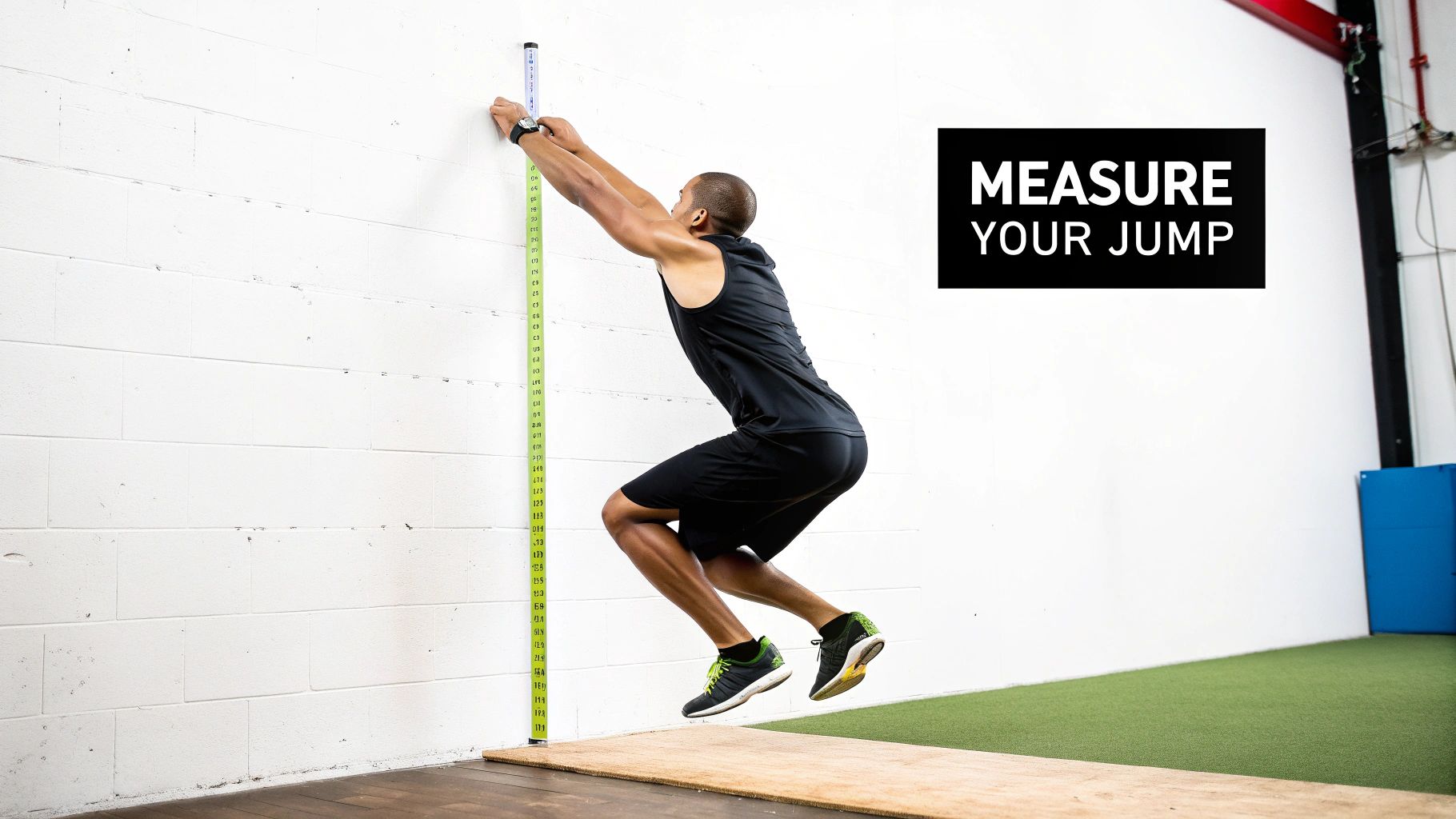
How to Nail the Vertical Jump Test
The simplest and most reliable way to get your number is with the classic 'Sergeant Jump' test. All you need is a wall and some chalk or tape. It’s a low-tech method that gives you the clean, repeatable data you need.
Here’s the right way to do it:
- Find your standing reach: Stand flat-footed, sideways against a wall. Reach up as high as you can with the hand closest to the wall and mark that spot. That’s your reach.
- Get ready to launch: Take a small step away from the wall. You can jump from a standstill or take a little preparatory step, but whatever you choose, stick with it for every future test to keep things consistent.
- Jump for the sky: Crouch down and explode upwards. Drive hard with your arms to get every last bit of momentum, and at the very peak of your jump, slap the wall as high as you can.
- Do the maths: The distance between your standing reach mark and your jump mark is your vertical leap. Give it three good attempts and take your best score. That's your baseline.
What Does Your Number Actually Mean?
Okay, so you have your number. What now? To put it into perspective, it helps to see how you stack up. This quick reference table, based on UK norms, can help you see where you're at and set some realistic goals.
UK Vertical Leap Benchmarks for Adults (in cm)
| Rating | Male (cm) | Female (cm) |
|---|---|---|
| Elite | 86.35 - 91.45 | 76.20 - 81.30 |
| Excellent | 66.04 - 71.12 | 55.88 - 60.96 |
| Good | 55.88 - 60.96 | 45.72 - 50.80 |
| Average | 50.80 | 40.64 |
| Below Average | 40.64 - 45.72 | 30.48 - 35.56 |
| Poor | < 35.56 | < 25.40 |
These benchmarks, referenced by organisations like the National Register of Personal Trainers (NRPT), show the massive difference a powerful leap can make, especially in sports like volleyball or basketball. An average adult male might land around 55 cm, with women around 45 cm, so you can see how much ground there is to gain.
Your baseline isn't a final grade; it's the starting line. The goal is to see this number consistently climb as a direct result of your hard work and smart training.
This number you just recorded is now your North Star. Make a plan to re-test yourself every 4-6 weeks. This regular check-in is your feedback loop. If the numbers are climbing, your training is working. If they've stalled, that’s your cue to switch things up—maybe it's time to increase the weight on your squats or focus more on your landing mechanics.
Building Your Engine with Strength and Power Training
Before you can even think about flying, you’ve got to build the engine that gets you off the ground. A truly explosive vertical leap is built on a non-negotiable foundation of raw strength. Think of your muscles as the engine; the stronger they are, the more power you can unleash in that split-second jump. This is where the real work begins.
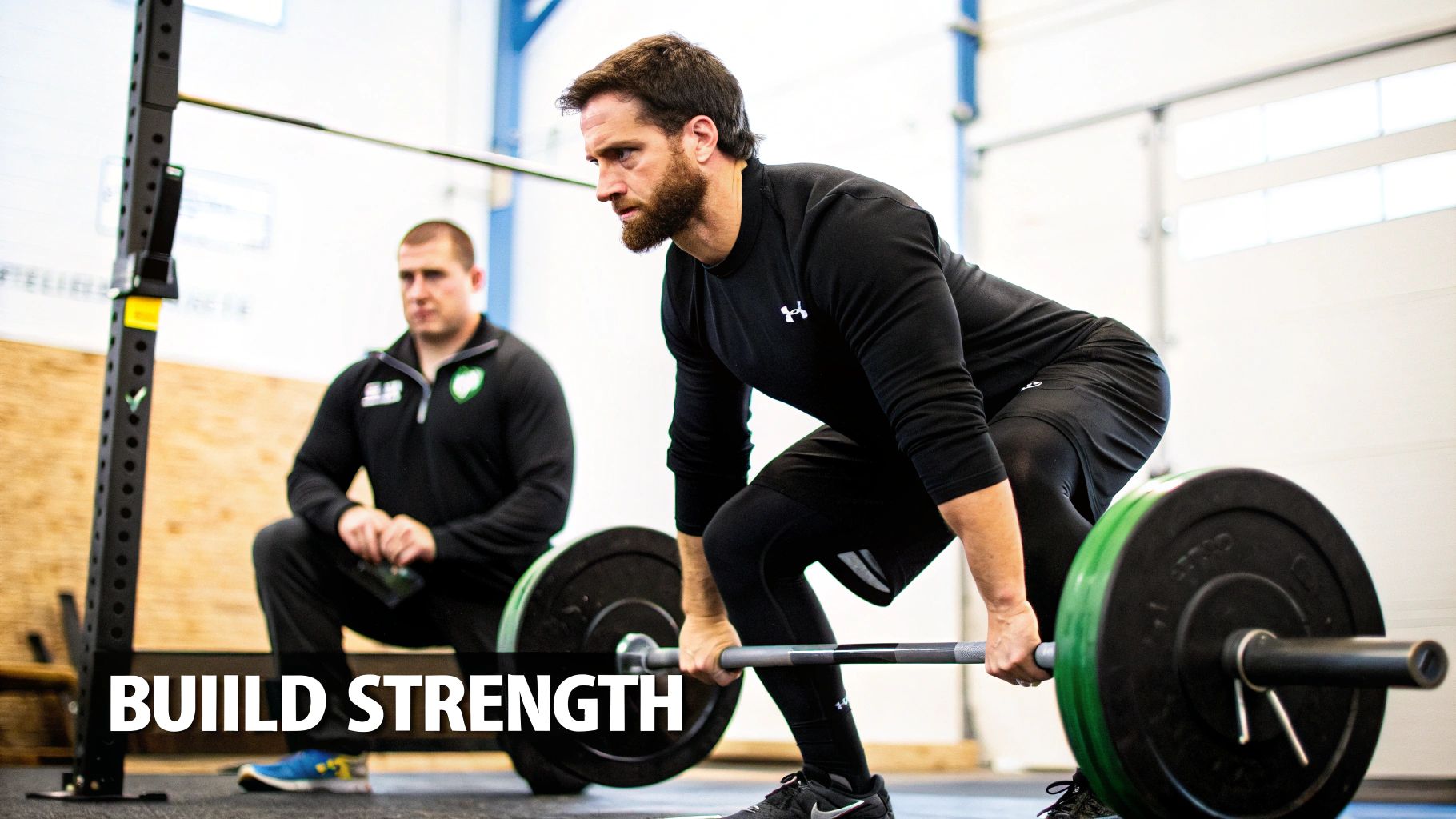
This phase isn't just about lifting heavy weights—it’s about lifting smart. The aim is to get brutally strong in the specific movement patterns that directly feed into your jump. Forget about isolation exercises like bicep curls. Your focus needs to be laser-sharp on the big, compound lifts that fire up your entire posterior chain—the glutes, hamstrings, and lower back—along with your quads. These are your powerhouse muscles.
The Cornerstones of Vertical Leap Strength
To build serious explosive potential, your training needs to revolve around a few key, high-impact exercises. I can't stress this enough: mastering the form on these lifts is critical. It’s not just about getting the most out of them, it’s about preventing the kind of injuries that can set you back for months.
Your programme should be built on these three pillars:
- Barbell Back Squats: This is the undisputed king of lower-body strength for a reason. Squats build foundational power in your quads, glutes, and hamstrings, perfectly mimicking the powerful hip and knee extension you need to launch yourself upwards.
- Deadlifts (Conventional or Trap Bar): Deadlifts are simply phenomenal for building raw, brute strength throughout the posterior chain. This movement teaches you to generate immense force from the ground up, a skill that is absolutely central to jumping higher.
- Lunges (and Variations): By introducing a unilateral (single-leg) element, lunges are vital for developing balance, stability, and power. So much of what we do as athletes, especially in sports like beach volleyball, happens off one foot.
For every one of these, prioritise perfect form over piling on the weight. It's far better to squat 60 kg with perfect technique than it is to ego-lift a sloppy, dangerous 100 kg.
Understanding Progressive Overload: The Key to Getting Stronger
Your muscles won't get stronger unless you give them a damn good reason to. That’s the principle of progressive overload, and it's the secret sauce to making consistent, long-term gains. In short, you have to consistently increase the demands you place on your body.
Here are a few practical ways to do it:
- Add More Weight: This is the most obvious one. Once you can comfortably hit your target reps and sets with good form, add a little more weight (even just 2.5 kg) in your next session.
- Add More Reps: If you can’t bump up the weight, try grinding out one more repetition on each set.
- Add More Sets: Simply add another full set of the exercise to your workout.
- Shorten Your Rest: Shaving a few seconds off the rest period between your sets makes the entire workout more intense.
This systematic approach is what forces your body to adapt and grow stronger. It's fundamental if you’re serious about knowing how to increase your vertical leap.
Every training session should be a deliberate step forward. Don't just go through the motions. Track your lifts and aim to beat your previous performance in some small way, every single week. That’s how real strength is built.
Rep Ranges for Maximum Power
How you lift is just as important as what you lift. To build the kind of strength that translates into explosive power, you need to be strategic with your sets and reps.
- For Pure Strength (The Engine): Focus on heavy lifts in the 3-5 rep range. This is the sweet spot for driving the neurological and muscular adaptations that lead to big strength gains. Aim for 3-5 sets with plenty of rest (2-3 minutes) in between to ensure you're lifting with maximum intent.
- For Power (The Accelerator): To train your muscles to produce force quickly, you have to move weight with speed. Exercises like kettlebell swings or explosive box squats, performed in the 5-8 rep range, are perfect for this.
A beginner might start with just their bodyweight for squats, focusing solely on nailing the technique. As they get stronger, they can progress to a goblet squat, and eventually, to heavy barbell back squats. This logical progression is the safest and most effective way to improve.
Many athletes find that getting intensive, hands-on coaching at a dedicated training camp, like a Beach Performance Camp, can dramatically speed up this learning curve with expert feedback on technique. Remember, strength is the foundation, but applying that strength with speed is what will send your vertical leap soaring.
Converting Strength into Explosive Jumps with Plyometrics
Having a strong engine from your strength training is one thing; learning how to redline it in an instant is a completely different skill. This is exactly where plyometrics come in.
Think of it as the transmission in a high-performance car. You’ve built the horsepower in the weight room, and now plyometrics will teach your body how to go from zero to one hundred in a heartbeat. It’s all about teaching your body to be springy and reactive, converting that raw strength into pure, explosive upward motion.
This kind of training is all about speed. It’s built around the stretch-shortening cycle (SSC), which is a fancy way of describing how your muscles lengthen and then immediately snap back, just like an elastic band. The faster you stretch it and let go, the more powerfully it snaps back. Plyometrics train your muscles and tendons to do just that—storing and releasing energy for a much more powerful jump.
But let’s be clear: jumping straight into high-intensity drills is a recipe for disaster. The foundation of any good plyometric programme is learning how to land safely and efficiently.
Mastering the Landing First
Before you can fly, you have to learn how to stick the landing. Every single jump ends with a landing, and if your mechanics are poor, you're not just leaking energy that could have gone into your jump; you're dramatically increasing your risk of injury. The goal is to land softly and quietly, like a cat.
A perfect landing always involves:
- Landing on the balls of your feet before your heels touch the ground.
- Bending at your ankles, knees, and hips all at once to absorb the impact.
- Keeping your chest up and your back straight, so you’re not collapsing forward.
- Making sure your knees track over your toes and don't cave inwards (a common and risky issue called valgus collapse).
Start simple. Step off a small box, maybe 15-30 cm high, and just focus on sticking the landing. Hold that final position for a few seconds to build stability and control. Once that feels second nature, you're ready to actually start jumping.
Foundational Plyometric Drills
With a solid landing in your back pocket, you can move on to the exercises that build your initial springiness and coordination. With these, focus relentlessly on flawless execution. Quality always trumps quantity in plyometrics.
- Box Jumps: The absolute classic. Find a box where you can land comfortably without having to tuck your knees way up to your chest. The goal here is to jump high and land softly, not just to scramble onto a high obstacle with terrible form.
- Broad Jumps: These are brilliant for developing horizontal power, which translates directly into a more explosive approach for a spike or block in beach volleyball. Explode forward as far as you can, but remember, the real test is sticking the landing without taking a single stumble.
These two exercises are your bread and butter. They build the fundamental reactive ability that all the more advanced stuff is built upon.
The ground is your best friend in plyometrics. Your goal is to spend as little time on it as possible. Think "quick and bouncy," not "slow and heavy." This reactive strength is what sends your vertical leap soaring.
Advanced Plyometrics for Maximum Force
Once you've built a solid base, you can start dialling up the intensity with drills that place a much greater demand on that stretch-shortening cycle. These are the exercises that really start adding centimetres to your jump, but they demand a high level of strength and technical skill. Don't rush into them.
- Depth Jumps: This is the gold standard for improving reactive strength. You step off a box (start low, around 30-40 cm), hit the ground, and immediately explode upwards into a maximum-effort vertical jump. The magic is in that instantaneous transition from landing to jumping.
- 180º Jumps: This drill adds a rotational element, which is crucial for sport-specific movements on the court. Do a squat jump, but rotate 180 degrees in the air, landing softly and in control, facing the opposite direction.
- Lateral Bounds: Explosiveness isn't just vertical. Bounding from side to side builds single-leg power and stability, which is essential for making those quick, agile plays on the sand or court.
Integrating these advanced movements requires careful planning. They are incredibly taxing on your central nervous system, so they should always be done when you’re fresh—usually right at the beginning of a workout after a thorough warm-up. Check out our complete volleyball vertical jump guide for more examples of how to sequence these exercises in a programme.
This isn’t just theory; the science backs it up. A comprehensive meta-analysis found that consistent plyometric training can boost vertical jump height by an average of 5.2 cm. For athletes in the UK, where the adult male average is around 55 cm, that kind of gain is significant and can push you into a completely different performance tier. You can read more about the research on plyometric training effectiveness to see just how quickly these gains can be realised.
Ultimately, a huge part of learning how to increase my vertical leap is mastering the art of converting strength into speed. Plyometrics are the bridge that connects the weight room to game-time performance, transforming your raw power into the explosive, match-winning jumps you're striving for.
Your 8-Week Vertical Leap Training Blueprint
Knowing about squats, deadlifts, and plyometrics is one thing, but having a solid plan to put it all together is what truly gets results. This is where the theory hits the gym floor. What follows is a practical, week-by-week schedule I've used with athletes to systematically boost their vertical leap over two months. It carefully balances strength work, explosive drills, and crucial recovery time into a programme you can actually stick to.
Forget the guesswork. This blueprint is broken down into two distinct, four-week phases. The first phase is all about building a rock-solid strength base and really nailing the fundamentals of jumping and landing. Then, in the second phase, we shift gears to focus on converting that strength into raw, explosive power.
Phase 1: Building Your Foundation (Weeks 1-4)
The goal for the first month is simple: get stronger and learn how to jump and land safely and efficiently. We're going to prioritise perfect form over piling on the weight or going for crazy-high jumps. This is where you lay the essential groundwork that allows for serious gains later on.
During this phase, you'll have two main training days each week. Make sure you give yourself at least 48 hours of rest between them—your muscles need that time to repair and grow stronger.
Day 1: Strength Focus This session is all about building the raw horsepower for your jump.
- Barbell Back Squats: 3 sets of 5 reps (Focus on deep, controlled movements).
- Romanian Deadlifts: 3 sets of 8 reps (Incredible for your hamstrings and glutes).
- Walking Lunges: 3 sets of 10 reps per leg.
- Plank: 3 sets, hold for 45–60 seconds.
Day 2: Plyometrics and Power Focus Here's where we start teaching that newfound strength to be fast and reactive.
- Box Jumps: 3 sets of 5 reps (Land softly, like a cat. Step down, don't jump, and reset).
- Broad Jumps: 3 sets of 5 reps (Focus on sticking the landing without any extra hops).
- Kettlebell Swings: 3 sets of 10 reps (This is a hip hinge, not a squat. Drive with your hips, not your arms).
- Medicine Ball Slams: 3 sets of 8 reps (Put everything you've got into it, generating power from your core).
Every plyometric exercise follows this simple but critical sequence.
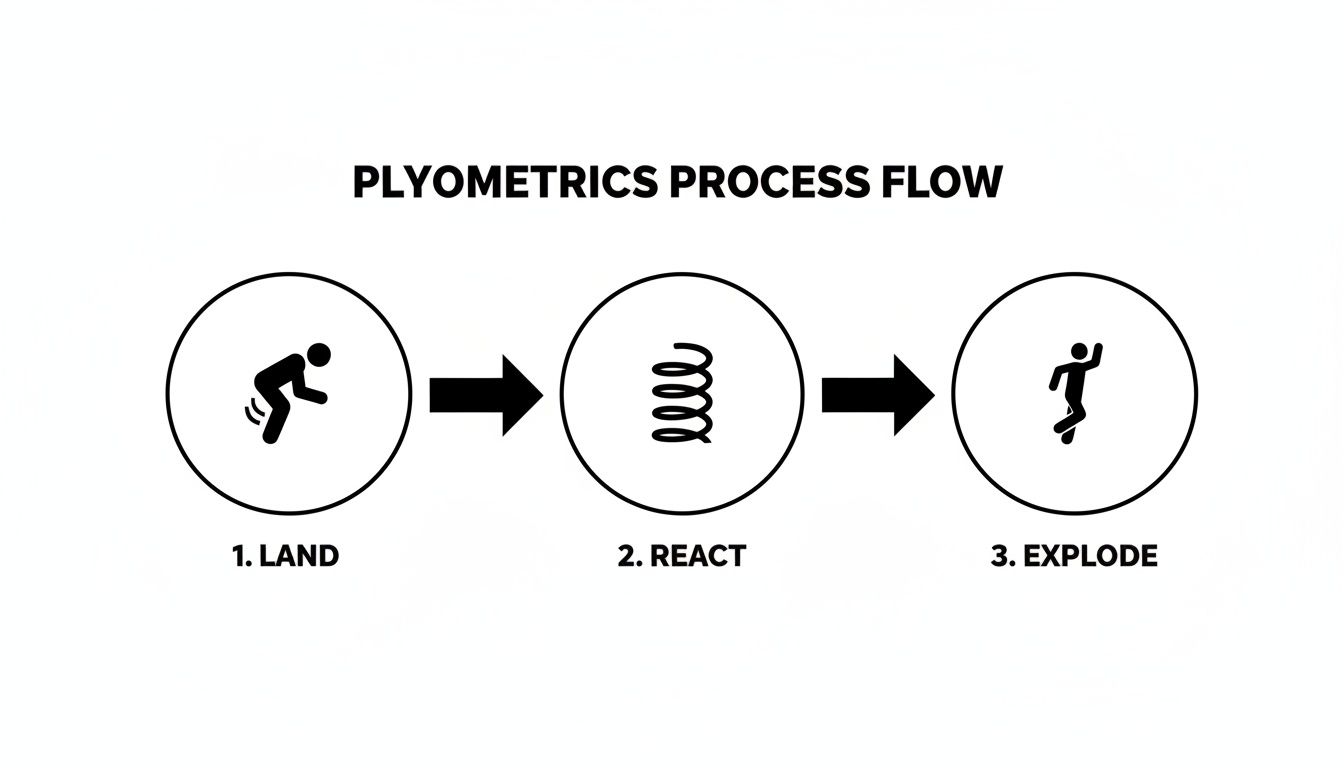
The real magic happens when you minimise the time you spend on the ground. Think of the floor as a hot surface—touch it and spring back up instantly.
Phase 2: Peak Power and Explosion (Weeks 5-8)
Okay, you've built a solid foundation. Now it's time to turn up the dial. In this phase, we'll introduce more advanced exercises and drop the reps on our main lifts. The goal is to move heavier weights with maximum speed, converting all that strength into pure vertical power.
We’re sticking to two main training days, but the exercises are more demanding. It's vital you listen to your body here and make sure you're fully recovered before hitting each session hard.
Day 1: Max Strength Focus We're lifting heavier for fewer reps to build that peak, top-end strength.
- Barbell Back Squats: 4 sets of 3 reps (Time to add some weight from Phase 1).
- Conventional Deadlifts: 3 sets of 3 reps (Focus on ripping the bar off the floor explosively).
- Bulgarian Split Squats: 3 sets of 6 reps per leg.
- Hanging Leg Raises: 3 sets of 10–12 reps.
Day 2: Advanced Plyometrics and Speed Focus This is where we sharpen your ability to explode upwards with higher-impact drills.
- Depth Jumps: 3 sets of 5 reps (Step off a 30–40 cm box and explode up the second you touch the ground).
- 180º Jumps: 3 sets of 6 reps (Control your rotation and land softly, ready for the next one).
- Lateral Bounds: 3 sets of 5 reps per side (Push off hard and cover as much ground as you can).
- Tuck Jumps: 3 sets of 8 reps (Focus on driving your knees up to your chest).
A Quick Word of Advice: This blueprint is a guide, not a rigid set of rules. If your form starts to break down, lower the weight. If an exercise causes pain, find a substitute that doesn’t. The smartest athletes I know are the ones who listen to their bodies.
Sample 8-Week Training Split
To make this even easier to visualise, here’s a simplified overview of how to structure your training week. This layout balances the intense days with recovery, which is where you actually get stronger.
| Day | Phase 1 (Weeks 1-4) | Phase 2 (Weeks 5-8) |
|---|---|---|
| Monday | Strength Focus | Max Strength Focus |
| Tuesday | Active Recovery / Mobility | Active Recovery / Mobility |
| Wednesday | Plyometrics & Power Focus | Advanced Plyometrics & Speed |
| Thursday | Active Recovery / Mobility | Active Recovery / Mobility |
| Friday | Optional Light Activity or Full Rest | Optional Light Activity or Full Rest |
| Saturday | Full Rest Day | Full Rest Day |
| Sunday | Full Rest Day | Full Rest Day |
Sticking to a schedule like this ensures you're hitting your muscles hard enough to force adaptation but also giving them the time they need to rebuild.
This 8-week plan gives you a balanced, progressive approach to developing both the engine (strength) and the skills to use it (plyometrics). For athletes wanting to push their limits with personalised coaching, a dedicated programme like a beach volleyball high-performance training camp can provide expert feedback in an intensive environment. But for most, sticking to this plan with consistency will absolutely teach you how to increase your vertical leap and deliver results you can see and feel.
The Mental Game: Sports Psychology and Tactical Integration
The biggest jumps in performance often come from the work you do between your ears and how you apply your physical gains on the court. It's the often-overlooked essentials—sports psychology and tactical awareness—that separate the good athletes from the great ones. Think of it as the high-performance software that runs your finely-tuned physical hardware.
Skipping this side of training is like having a Formula 1 car but no driver. You can have all the physical power in the world, but if you can't access it under pressure or use it intelligently, your progress will stall.
Mental Reps: Visualization and Confidence
To jump your highest, you need to believe you can. Sports psychologists like those at the Association for Applied Sport Psychology (AASP) have long shown the power of mental rehearsal. Before a game or a big jump test, take a few minutes to vividly visualize yourself executing a perfect jump. Feel the power in your legs, the explosive launch, and the effortless landing. This isn't just daydreaming; it's priming your nervous system for success. Confidence is built on repetition, both physical and mental.
Tactical Application in Beach Volleyball
For beach volleyball players, a higher vertical is useless without tactical intelligence. Your jump is a tool. How do you use it?
- Blocking: A higher leap is great, but timing is everything. A key team tactic is for blockers to communicate with their defenders to cover specific zones. A "line" block forces the attacker to hit cross-court, where the defender is waiting. Your jump is the final piece of this strategic puzzle, not the whole game plan.
- Attacking: Can you hit different shots from your peak height? A powerful spike is one option, but a well-placed "poke" or "cut" shot can be just as effective. Top teams use a varied attack, reading the defense and using their vertical to create multiple threats. As a resource, the experts at Better at Beach offer exceptional tactical breakdowns.
Your physical gains are a force multiplier for your strategy. Don't just jump higher—jump smarter. Your team's success depends on integrating your improved vertical into a cohesive game plan.
Smart Recovery and Mobility
Your muscles don't get stronger in the gym; they get stronger while you rest. Pushing your body with intense training is only half the equation. The other half is giving it the time and resources it needs to repair, adapt, and come back stronger.
First and foremost is sleep. Aiming for 7-9 hours of quality sleep per night is non-negotiable. This is when your body releases growth hormone, which is vital for muscle repair and a key factor in how you increase your vertical leap.
Next, bring in active recovery techniques. Simple foam rolling sessions can help reduce muscle soreness and improve blood flow. For nagging aches, some athletes find real relief and support using specific taping methods. You can learn more about how volleyball kinesiology tape can aid recovery in our detailed player's guide.
Finally, you have to listen to your body. Feeling unusually fatigued or sore is a clear signal that you need more rest, not another punishing workout. Pushing through is a fast track to overtraining and burnout.
Fuel Your Jump with Proper Nutrition
You can’t out-train a poor diet. Plain and simple. Your nutrition provides the raw materials your body needs to perform at its best and recover fully.
Keep your approach straightforward and focus on the fundamentals.
Make sure you're getting enough protein to repair the muscle damage from your workouts—think lean meats, fish, eggs, and legumes. Combine this with quality carbohydrates like oats, brown rice, and sweet potatoes to replenish your energy stores, fuelling your next explosive session. And don't forget hydration; even slight dehydration can significantly hurt your performance.
Your Top Jump Training Questions, Answered
Even with the best training plan laid out, you're bound to have questions. Let's tackle some of the most common hurdles and myths I see athletes struggle with when they're trying to add inches to their vertical. Think of this as your straight-to-the-point guide for fine-tuning your training and staying on track.
How Long Does It Really Take to See a Higher Vertical?
This is the big one, isn't it? Everyone wants to know the timeline. The honest-to-goodness answer is that it all comes down to consistency.
While everyone's body is different—your genetics and starting fitness play a big role—most athletes who truly stick with a structured programme will feel and see a noticeable difference within four to six weeks.
But for those game-changing gains, the kind that gets you 5-10 cm higher? You're looking at eight to twelve weeks of focused, dedicated work. I always tell my athletes to test their jump every four weeks. Seeing that number climb is a massive motivator and proves the grind is worth it.
Should I Train Jumps on Sand or Stick to the Gym Floor?
This isn't an either/or question; it’s about using the right surface for the right job.
Think of the gym as your engine room. This is where you build your raw power. Your heavy strength work—squats, deadlifts—and your most intense plyometrics, like depth jumps, need a stable, hard surface. It’s the only way to generate maximum force safely.
But sand? For a beach volleyball player, it's an incredible training tool. It’s a low-impact surface that's fantastic for building up specific ankle stability and conditioning your legs for explosive movements without the pounding your joints take on a hard court.
A smart approach combines both. Build your engine in the gym, then head to the sand to fine-tune that power with sport-specific drills. This article on developing functional athletic strength has some great insights on blending different training environments effectively.
What Are the Biggest Mental Blocks to Jumping Higher?
Jumping higher is just as much a mental game as it is a physical one. I've seen two major psychological hurdles stop countless athletes from reaching their potential.
The first is a fear of injury. It's often subconscious, but it makes you hesitate. You hold back just a little, never fully committing to that all-out effort. You simply can't explode up if part of your brain is worried about coming down.
The second is frustration from slow progress. Plateaus are a normal part of any training journey. It’s so easy to get discouraged when your vertical doesn’t increase every single week.
To break through these mental barriers, shift your focus to mastering perfect form on every single rep. When you move well, you build trust in your body's ability to handle the intensity. And remember, progress is never a straight line. Celebrate the small victories, trust the process, and know that consistent, focused effort is what separates good from great.
What Are the Most Common Training Mistakes People Make?
So many athletes work incredibly hard but end up sabotaging their own progress by falling into a few common traps. Avoiding these is just as crucial as doing the right exercises.
From what I’ve seen, these are the three biggest culprits:
- Overtraining: This is number one, by a long shot. Athletes get amped up and just do too much, too soon, without enough rest. Your body gets stronger when it recovers, not when you're working out.
- Skipping Strength Day: A lot of people think they can get a higher vertical just by jumping more. But you can't be explosive without a solid foundation of strength. Doing only plyometrics without building that base is like trying to fire a cannon from a canoe.
- Poor Landing Mechanics: This is a huge one. Every sloppy landing not only leaks power that should have gone into your jump, but it also dramatically increases your risk of knee and ankle injuries.
Always, always prioritise the quality of your movement over the quantity of your reps. Schedule your rest days and learn to listen to your body—it’s the smartest coach you'll ever have.
Ready to put this knowledge into action with expert guidance? At MyNextCamp, we connect you with the best beach volleyball camps around the world, from intensive training clinics to fun vacation camps. Find the perfect programme to take your game to the next level. Discover your next camp at https://mynextcamp.io.
64 Aufrufe
Finde dein nächstes Camp
Vergleiche Beachvolleyball-Camps in ganz Europa. Filtere nach Land, Datum und Preis.