
The Ultimate Drill for Volleyball: 8 Beach Tactics to Master in 2026
•MyNextCamp Team
Elevate your game with our ultimate drill for volleyball guide. Discover 8 essential beach volleyball drills for improved tactics and mental toughness.
Welcome to the definitive guide for every aspiring and established beach volleyball player. Moving beyond generic advice, this article delves into the core of high-performance training: targeted, actionable drills that build not just skill, but tactical intelligence and mental resilience. We're focusing on the beach game, where the two-person team dynamic demands a unique blend of individual mastery and seamless partnership. This isn't just a list; it's a structured training philosophy designed to elevate every aspect of your performance.
We will explore each drill for volleyball with a focus on team tactics, the psychological edge needed to win, and how to implement them effectively in your practice sessions. From fundamental passing and setting progressions to complex game-situation scrimmages, you'll find everything you need to organise a productive and challenging training day. We’ll break down each exercise into clear steps, offer variations for different skill levels, and provide crucial coaching tips to maximise your development.
For players looking to take their training to the next level, finding a camp that incorporates these proven methods is key. These drills form the foundation of high-quality coaching programmes around the world. Platforms like MyNextCamp are invaluable resources for locating specialised beach volleyball camps that focus on this kind of intensive, results-driven training, helping you connect with expert coaches and programmes that align perfectly with your development goals. Whether you are coordinating a training trip with friends or seeking a solo camp experience, this guide will provide the blueprint for meaningful improvement on the sand. This comprehensive collection is your resource for building a versatile, intelligent, and formidable beach volleyball game from the ground up.
1. Pass, Set, Hit Progression Drill
The Pass, Set, Hit Progression is the foundational drill for volleyball, simulating the core three-touch sequence of a rally. This drill is essential for building the muscle memory and coordinated rhythm required to transition from defence to offence effectively. It establishes the fundamental framework upon which all other team tactics are built, making it an indispensable starting point for any training camp, regardless of the players' skill level. Its universal application is why it's a staple in developmental programmes run by leading bodies like the FIVB and USA Volleyball.
This drill reinforces the entire offensive system in a controlled, repetitive environment. By isolating the pass-set-hit sequence, players can concentrate on technical precision, communication, and seamless movement between each contact. It’s not just a physical exercise; it's a mental one that trains players to anticipate the flow of play and understand their role within the rally. From a sports psychology standpoint, perfecting this sequence builds confidence, allowing teams to run their offense automatically under pressure.
How It Works
At its core, the drill involves a coach or feeder initiating a ball to Player 1 (the passer). Player 1 passes to Player 2 (the setter), who sets the ball for Player 1 to approach and attack over the net. This simple loop is repeated to build consistency. The objective is to perfect each touch, ensuring the pass is on target, the set is hittable, and the attack is effective. For a deeper understanding of the technical elements, effective coaching for volleyball is paramount, as it helps players refine their individual skills within the team dynamic.
Progressions and Variations
To keep this drill for volleyball challenging and game-like, coaches can introduce several variations:
- Add Movement: Instead of starting in a static position, players can begin at the back line and move forward to pass, simulating a serve receive.
- Target Zones: Place targets (cones or towels) on the court for the passer, setter, and hitter to aim for. This sharpens accuracy under pressure.
- Off-Platform Passes: The coach can initiate the ball away from the passer, forcing them to move and make a pass from a less-than-ideal body position (an "off-platform" pass).
- Add a Blocker: Introduce a passive or active blocker at the net to force the attacker to make smarter shot selections, like a high-line shot or a cut shot.
Coaching Tip: Emphasise communication throughout the drill. The passer should call the ball, and the setter should communicate the type of set. This verbal coordination is just as crucial as the physical execution, especially in the two-person beach game. This builds the trust essential for advanced beach volleyball tactics.
2. Pepper Drill
The Pepper Drill is arguably the most classic and versatile warm-up in volleyball, embodying the rhythmic exchange of passing, setting, and hitting between two partners. Named for its rapid, "peppery" pace, this drill is fundamental for developing ball control, touch, and communication. It serves as an essential pre-practice or pre-match routine, used by everyone from beginners at UK-based beach volleyball camps to Olympic athletes preparing for a final. Its simplicity and effectiveness are why it’s endorsed by organisations like USA Volleyball and the FIVB.
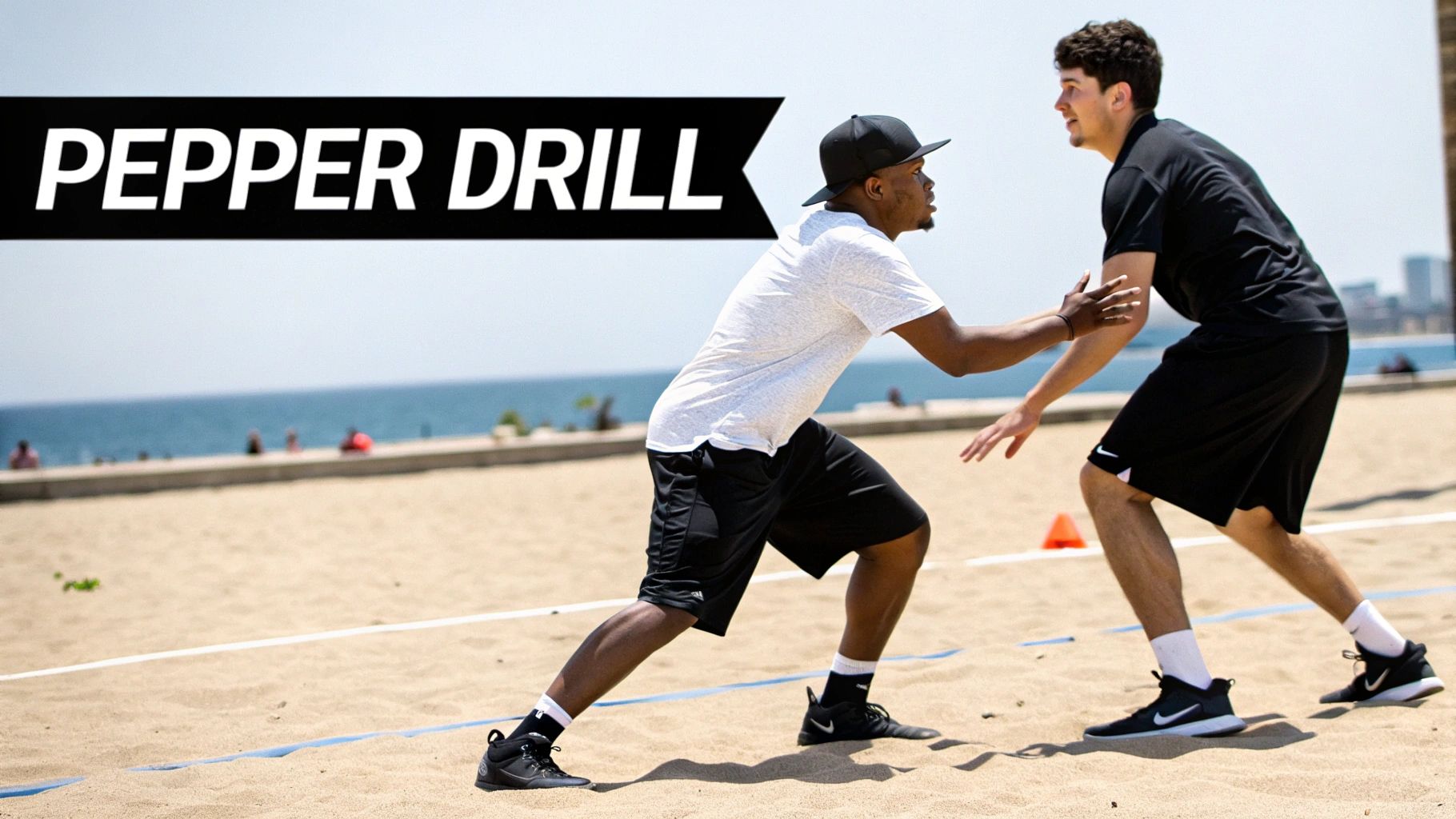
This drill for volleyball is more than just a warm-up; it’s a focused exercise in consistency and partner synchronisation. The constant, controlled touches build a player’s feel for the ball and reinforce the correct posture and technique for each skill. By engaging in this cooperative rally, players sharpen their reaction time and learn to read their partner's movements, fostering the non-verbal understanding crucial for team sports psychology and on-court success.
How It Works
Two players stand facing each other, several metres apart. Player A initiates the sequence by hitting a controlled "downball" (a soft, downward-arcing attack) to Player B. Player B digs the ball up to themselves, sets the ball to themselves, and then hits a controlled downball back to Player A. The cycle repeats, creating a continuous flow of dig-set-hit on both sides. The primary goal is to maintain the rally for as long as possible, focusing on clean, precise contacts.
Progressions and Variations
To enhance the challenge and target specific skills, coaches can adapt the Pepper Drill with several modifications:
- Vary the Distance: Start close together to work on fine motor control and quick touches, then gradually move farther apart to practise deeper passes and more powerful attacks.
- One-Touch Pepper: Instead of the dig-set-hit sequence, players pass the ball back and forth using only one contact, forcing quicker reactions and better platform control.
- Alternating Contacts: Players can alternate between forearm passing and overhead setting on each contact, improving their ability to handle balls at different heights and speeds.
- Movement Pepper: One player can move the other around the court by hitting the ball to their left and right, forcing them to incorporate footwork and off-platform control.
Coaching Tip: Focus on quality over speed. Encourage players to start slowly, concentrating on perfect form for each touch. As control improves, they can naturally increase the pace. This progressive approach builds a solid foundation and prevents bad habits from forming.
3. Serving and Receiving Drill
The Serving and Receiving Drill is a fundamental practice that isolates the two most crucial first contacts in a rally. A strong serve can dictate the entire point, while a precise pass provides the foundation for a successful attack. This drill sharpens both skills simultaneously, creating a high-pressure, game-like environment that is essential for developing competitive resilience. Its emphasis on tactical serving and stable reception is a core component of training in European and Australian beach volleyball development pathways.
This drill forces players to focus on the tactical battle that opens every rally. For the server, it’s about more than just getting the ball over; it’s about targeting weaknesses and disrupting the opponent's system. For the receiver, it’s an exercise in reading the server, anticipating the ball's trajectory, and delivering a perfect pass to the setter. This dual focus makes it a highly efficient drill for volleyball practice sessions.
How It Works
One player (or a line of players) starts at the baseline with a basket of balls to serve. Across the net, a pair of players is positioned in their serve-receive formation. The server aims for specific zones or players, while the receivers work on their communication ("Mine!", "Yours!") and passing technique to deliver the ball to a designated target area near the net. After a set number of serves, players rotate roles. The objective is to sustain high-quality reps for both serving and passing.
Progressions and Variations
To enhance the challenge and replicate match intensity, coaches can introduce several variations:
- Point-Based System: Award points for aces or perfect passes (e.g., three points for an ace, one point for a pass that lands in the target zone). This adds a competitive edge.
- Serve Variation: Mandate servers to alternate between aggressive jump serves and tricky float serves, forcing receivers to adjust to different speeds and movements.
- Pressure Receiving: Have two servers serve alternately at the same receiving pair, reducing recovery time and simulating the mental pressure of being targeted in a match.
- Serve-to-Attack: After the pass, a coach or designated setter sets the ball back to the passer, who then completes an attack. This connects the first contact to the offensive outcome.
Coaching Tip: Emphasise the mental game. Servers should identify and target the weaker passer or exploit the space between players. Receivers should focus on a simple, calming pre-pass routine to maintain composure under pressure, a key aspect of beach volleyball tactics.
4. King of the Court (KOC) Drill
King of the Court (KOC) is a high-energy, competitive drill that simulates the pressure and intensity of tournament play. It’s designed to keep multiple teams engaged simultaneously, where one team defends the "king" or championship side of the court, while challenger teams rotate in to try and dethrone them. This format is exceptional for developing mental toughness and performance under pressure, making it a cornerstone drill in professional AVP training camps and European club programmes preparing for national competitions.
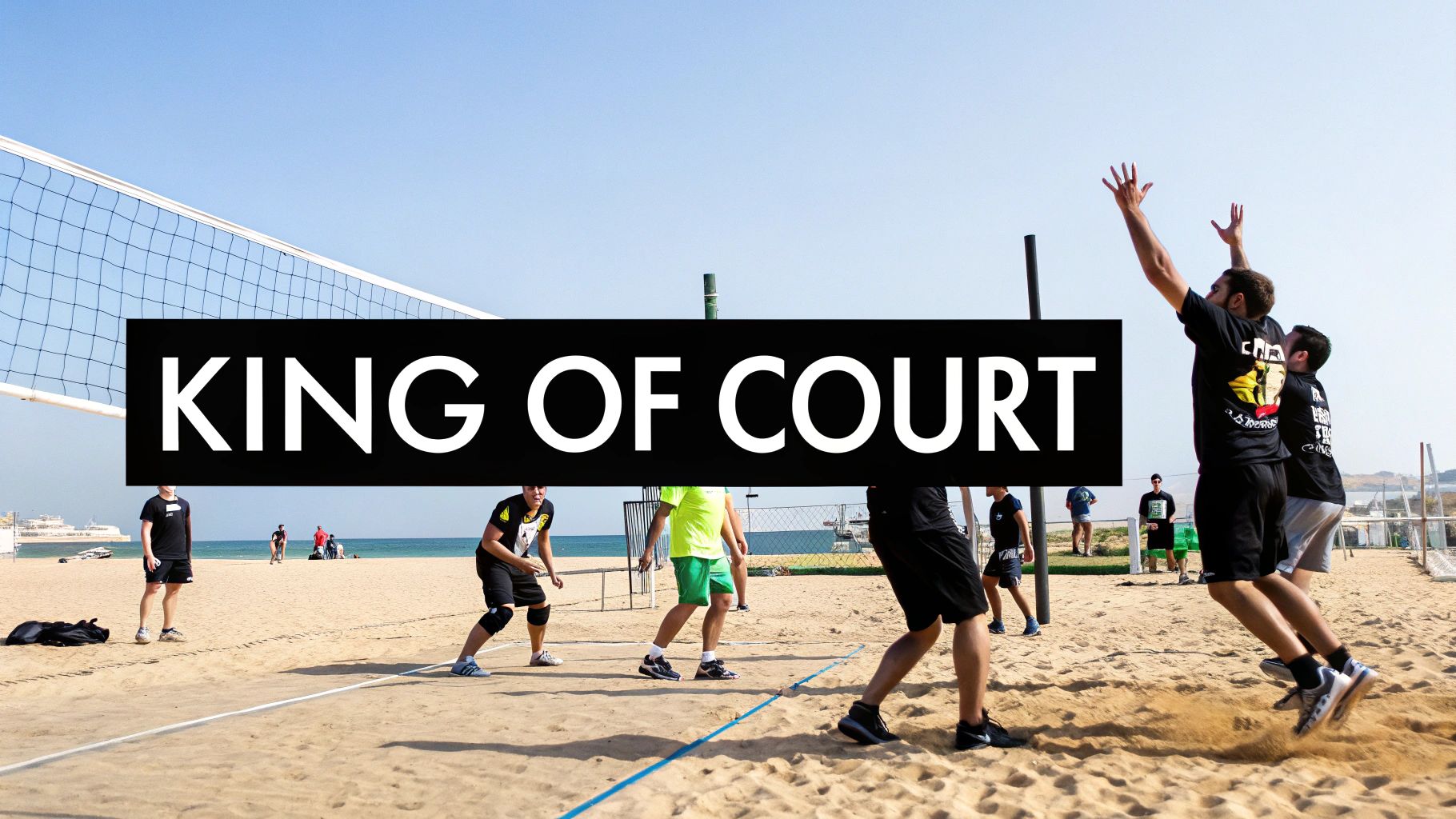
This drill for volleyball excels at replicating the stop-start nature of a real match, forcing players to quickly reset after each point, whether they win or lose. The continuous flow and high stakes sharpen focus, decision-making, and communication in game-realistic scenarios. From a sports psychology perspective, it trains athletes to manage adrenaline, maintain composure, and stay aggressive when it matters most, key concepts explored by experts like Dr. Jim Loehr in "The New Toughness Training for Sports".
How It Works
The drill begins with one team on the "King's" side and a line of challenger teams on the other. A coach or feeder initiates a play, and the teams play out a single rally. If the challenger team wins, they run under the net and take over the King's side. The losing King team goes to the back of the challenger line. If the King team wins, they stay, and the next challenger team steps up. The objective is to win consecutive points and remain on the King's side for as long as possible.
Progressions and Variations
To maximise competitiveness and skill development, coaches can adapt the KOC format:
- Scoring Variations: Instead of a single rally, teams can play to 3 or 5 points. The first team to reach the target score stays on the King's side.
- Handicap System: To balance mixed-skill groups, give less experienced teams a point advantage (e.g., they start each game at 1-0).
- Conditioned Play: Introduce specific rules, such as "no hard-driven spikes" to focus on shot-making, or "the rally must include one option play" to practise team tactics.
- Multi-Court KOC: For larger groups, run KOC on multiple courts, with a "King Court," "Queen Court," and "Joker Court." Winners move up a court, and losers move down, creating a dynamic ladder system.
Coaching Tip: Use King of the Court as a capstone drill at the end of a session when players are fully warmed up. The high intensity is perfect for applying the skills worked on earlier. Ensure clear rules and balanced teams are established beforehand to maintain a fair and engaging competitive environment.
5. Blocking and Hitting Combination Drill
The Blocking and Hitting Combination Drill is a dynamic, coordinated exercise that builds both offensive and defensive mechanics at the net. It forces players to alternate between attacking and blocking roles, developing the crucial ability to read, time, and react to their opponent. This complementary drill is a cornerstone of balanced skill development and is frequently used in high-level programmes, from the Brazilian beach volleyball development system to Olympic preparation camps.
This drill for volleyball builds a symbiotic relationship between attacking and blocking. By practising both sides of the net simultaneously, players gain a deeper understanding of the cat-and-mouse game between hitter and blocker. An attacker learns to recognise a well-formed block and make smarter shots, while a blocker learns to anticipate a hitter’s tendencies and positioning. It’s an exercise in both physical execution and sports psychology, teaching players to out-think their opponents.
How It Works
Two players stand on opposite sides of the net. Player A starts as the hitter, and Player B is the blocker. A coach or third player tosses a set to Player A, who performs an attack. Player B reads the approach and jumps to execute a block. Immediately after the play, the roles switch: Player B moves to an attacking position, and Player A becomes the blocker for the next repetition. The objective is for both players to refine their timing, positioning, and decision-making in their respective roles.
Progressions and Variations
To enhance this drill and adapt it for different skill levels, coaches can introduce several modifications:
- Add Movement: Instead of starting at the net, have the blocker begin in a defensive posture and move forward to block, simulating a transition from defence to blocking.
- Vary the Attack: The coach can provide different types of sets (fast, high, inside, outside) to force the hitter to adjust their attack and the blocker to adapt their timing.
- Blocker Calls: The blocker can call out the shot they are taking away (e.g., "line" or "angle"), forcing the hitter to attack the open court and training the defender behind the block.
- Increase Power: For advanced players, a strong block can directly influence how to achieve a higher vertical jump, as it requires maximum explosive power to penetrate the net.
Coaching Tip: Emphasise hand and body positioning for blockers. Their goal isn't just to touch the ball but to penetrate the net and angle their hands to direct the ball into the opponent's court. Use film review to analyse timing and positioning.
6. Setting Accuracy and Placement Drill
A precise set is the linchpin of a successful offence, transforming a good pass into an unstoppable attack. The Setting Accuracy and Placement Drill is a specialised exercise designed to hone a setter's technical precision, consistency, and strategic decision-making. This drill moves beyond simply getting the ball up; it focuses on delivering the ball to specific zones, at optimal heights, and with a tempo that empowers the hitter. Its central role in setter development makes it a cornerstone of programmes run by USA Volleyball and top European professional academies.
This drill isolates the art of setting, allowing players to concentrate on hand-contact, footwork, and ball placement without the immediate pressure of a full rally. For a setter, this repetitive practice builds the muscle memory needed to deliver consistent, hittable balls from any position on the court. It also develops the crucial mental connection between seeing the defence and choosing the right offensive play, a skill popularised by tactical masters like Misty May-Treanor.
How It Works
The fundamental setup involves a feeder (coach or partner) tossing or passing balls to the setter, who is positioned near the net. The setter's goal is to set the ball to a pre-determined target on the other side of the court, such as a cone, hoop, or marked zone representing an attacker's ideal hitting window. The drill focuses on repeating this action to refine technique and achieve a high percentage of accurate sets. For those looking to dive deeper into the nuances of hand position and follow-through, mastering sets in volleyball is key to turning good technique into great performance.
Progressions and Variations
To ensure this drill for volleyball remains challenging and translates to game situations, coaches should introduce progressive complexity:
- Numbered Zones: Place numbered targets along the net. The feeder calls out a number just before the pass, forcing the setter to react and adjust their set placement quickly.
- Varied Passes: The feeder can send passes that are low, high, tight to the net, or off the net, training the setter to adapt their footwork and body position.
- Add Hitter Movement: Have an attacker approach the net, so the setter learns to place the ball in their path, leading them into their swing.
- Incorporate Defensive Pressure: Add a passive blocker who simply stands at the net, forcing the setter to consider setting away from the block or pushing the ball tighter.
Coaching Tip: Use video analysis to give setters immediate visual feedback. Recording sets from the side and behind can reveal subtle inconsistencies in hand shape, arm extension, or follow-through that are difficult to spot in real-time. Tracking accuracy percentages over time is a great motivator.
7. Defense and Positioning Drill (Shuffles, Lateral Movement)
The Defense and Positioning Drill is a footwork-intensive exercise that forms the bedrock of a strong beach volleyball defence. It focuses on developing the lateral mobility, agility, and quick reactive movements essential for covering the expansive sand court. This drill trains players to shuffle, slide, and position themselves correctly to dig attacks, turning potential points for the opposition into offensive opportunities. Its emphasis on court coverage is why it is a fundamental component of training camps on the AVP tour and in European beach volleyball academies.
This drill directly improves a player's ability to anticipate and react, which is crucial in a two-person game where court coverage is paramount. By repetitively practising these movements, players build the muscle memory needed to move efficiently without thinking, allowing them to focus entirely on reading the attacker. From a sports psychology perspective, this automation builds defensive confidence, reducing anxiety during high-pressure rallies. It's a foundational drill for volleyball that builds defensive resilience and consistency.
How It Works
The drill begins with two players on one side of the court in their base defensive positions. A coach or partner on the other side of the net points or tosses balls to different spots, forcing the players to move laterally, forwards, and backwards. The objective is not just to get to the ball, but to arrive in a balanced, low position, ready to make a controlled dig. The key is maintaining proper footwork: shuffling to stay square to the net and using crossover steps for greater distances.
Progressions and Variations
To enhance this drill for volleyball and simulate match-like pressure, coaches can introduce several progressions:
- Verbal Cues: Instead of pointing, the coach calls out directions ("left," "right," "short," "deep") to train auditory reaction time.
- Add an Attacker: Replace the tosser with a live attacker who hits various shots, forcing defenders to read the hitter's arm and body language to anticipate the ball's direction.
- Reaction Balls: Use an unpredictable reaction ball or have the coach hit balls off a blocker's hands to simulate deflections and chaotic plays.
- Dig-to-Target: Players must not only dig the ball but also direct it to a specific target zone, simulating the transition from defence to offence.
Coaching Tip: Emphasise maintaining a low centre of gravity throughout every movement. Players should feel like they are gliding across the sand rather than hopping. This low, balanced stance is crucial for absorbing the pace of the ball and making a controlled, accurate dig.
8. Rally and Scrimmage Drill
The Rally and Scrimmage Drill is the ultimate test of a player's ability, combining all volleyball skills into a live, game-like environment. This drill bridges the gap between isolated practice and actual competition, forcing players to apply their serving, passing, setting, attacking, blocking, and defensive abilities in dynamic, unpredictable sequences. It’s a cornerstone of training for all professional organisations, from the AVP to the FIVB World Tour, because it reveals how well skills hold up under pressure.
This drill for volleyball moves beyond mechanical repetition to focus on tactical decision-making, team chemistry, and court awareness. By simulating match conditions, it helps players develop the sports psychology needed to manage in-game stress, communicate effectively with a partner, and make smart strategic choices. It is the most authentic way to prepare for the demands of a real tournament.
How It Works
The drill involves players competing in full or modified games, starting with a serve and playing out the point until the ball is dead. The primary objective is to score points while executing skills and tactics rehearsed in other drills. The format can be a standard game to 21 points, or shorter, objective-based rallies, such as first-to-five-points. This provides the most realistic context for skill application.
Progressions and Variations
To maximise learning and keep the drill competitive, coaches can introduce several modifications:
- Modified Court Size: For younger or less experienced players, shrinking the court size encourages longer rallies and more touches.
- Specific Tactical Objectives: Dedicate a scrimmage to a particular goal, such as 'all attacks must be deep-court' or 'focus on targeting the weaker passer'. This trains players to execute a game plan.
- Wash Drills: In this variation, a team must win two or three consecutive points to "wash" out and earn a single point. This format rewards consistency and mental toughness.
- Coaching Stoppages: The coach can pause the rally to provide immediate, in-context feedback on positioning, communication, or a tactical error.
Coaching Tip: Film scrimmage sessions for detailed post-training analysis. Watching game film allows players to see their positioning and decision-making from an objective viewpoint, revealing habits and patterns that are difficult to notice in the heat of the moment.
Comparison of 8 Volleyball Drills
| Drill | Implementation complexity | Resource requirements | Expected outcomes | Ideal use cases | Key advantages |
|---|---|---|---|---|---|
| Pass, Set, Hit Progression Drill | Low–Moderate; scalable progressions | Minimal: ball, partner/small group, optional net | Solid three-touch mechanics, timing, communication | Foundational sessions for beginners → intermediate | Teaches core offensive structure; directly match-applicable |
| Pepper Drill | Low; simple partner routine | Minimal: two players and a ball | Improved touch, consistency, quick-feet warm-up | Warm-ups and short drills for all skill levels | Time-efficient; builds partner communication and consistency |
| Serving and Receiving Drill | Moderate; technical coaching needed | Net, court space, target zones, multiple balls | Better serve variety, placement accuracy, reactive passing | Competitive-focused training and serve/receive development | Addresses two match-critical elements simultaneously |
| King of the Court (KOC) Drill | Moderate; logistics and rotation management | Multiple courts, groups, scoring system, supervision | High-intensity match simulation, competitive resilience | Intermediate/advanced camps and large-group competitive sessions | Highly motivating; efficient large-group, pressure-based training |
| Blocking and Hitting Combination Drill | Moderate–High; emphasis on timing and safety | Net, partners, coach supervision, adequate space | Improved blocking timing, attack coordination, jump mechanics | Advanced camps focused on front-row skills and dual-role players | Develops offense and defense simultaneously; builds explosiveness |
| Setting Accuracy and Placement Drill | Moderate; repetition and feedback required | Balls, targets/markers, video feedback optional | Precise set placement, improved setter decision-making | Setter-specific tracks and position-focused sessions | Produces consistent setters; measurable accuracy gains |
| Defense and Positioning Drill (Shuffles, Lateral Movement) | Moderate; high physical demand | Space, cones/markers, conditioning equipment | Enhanced lateral mobility, anticipation, digging consistency | Defensive-focused camps and sand-specific conditioning | Significantly improves court coverage and defensive range |
| Rally and Scrimmage Drill | Moderate; needs experienced supervision | Full court, multiple players, coach oversight | Integrated skill application, tactical awareness, endurance | Match preparation, end-of-session realistic practice | Most realistic simulation of match play; comprehensive skill integration |
Integrating Drills Into a Winning Strategy
The journey from a recreational player to a formidable beach volleyball competitor is paved with purposeful practice. This article has detailed eight fundamental drills, each designed to hone a specific aspect of your game, from the precision of a serve to the tactical awareness of a game-situation scrimmage. However, the true secret to unlocking your potential lies not just in executing each drill for volleyball in isolation, but in understanding how they interconnect to form a cohesive, powerful strategy on the sand.
Think of it as building a system. Your success in the Serving and Receiving Drill directly impacts your ability to initiate a strong first contact. This, in turn, provides the foundation for the Setting Accuracy and Placement Drill, giving your setter a clean platform to deliver a hittable ball. A well-executed set then creates the opportunity for a powerful attack, refined through the Pass, Set, Hit Progression and Blocking and Hitting Combination Drills. Each skill scaffolds the next, creating a chain of excellence that holds up under pressure.
From Repetition to Instinct: The Psychological Edge
At its core, a drill for volleyball is about building muscle memory through repetition. But advanced training transcends mere physical repetition; it cultivates a psychological edge. When you've practised thousands of defensive shuffles or peppered countless balls, your reactions become instinctual. You no longer have to consciously think, "I need to get my feet to the ball," your body simply does it.
This automation of fundamental skills frees up your cognitive resources to focus on higher-level strategy: reading your opponent, communicating with your partner, and making split-second tactical decisions. Drills like King of the Court are invaluable because they simulate the mental fatigue and pressure of a real match, training your mind to stay sharp when your body is tired. This is where the principles of sports psychology become critical. Visualising success before a serve or using positive self-talk after a mistake are skills that can be practised and integrated right alongside your physical drills.
Building a Cohesive Team Strategy
Beach volleyball is a partnership, and your training must reflect that. The drills outlined here are designed not just for individual skill development but for fostering team cohesion. Effective communication, understanding your partner’s tendencies, and moving as a single, synchronised unit are the hallmarks of an elite team.
- Passing and Setting: These drills build trust. The passer must trust the setter to get to the ball, and the setter must trust the passer to deliver a playable platform.
- Defence and Blocking: This is about shared responsibility. Drills that combine these elements force partners to communicate who is taking which area of the court, creating a defensive wall that is difficult to penetrate.
- Rally and Scrimmage: This is where it all comes together. Game-situation drills test your team's ability to transition from defence to offence, problem-solve in real-time, and execute your strategy under the duress of a live point.
Ultimately, the goal is to transform this collection of individual drills into a comprehensive, dynamic training plan. By consistently blending technical repetition with tactical, game-like scenarios, you will not only improve your individual skills but also forge a resilient and intuitive partnership. This holistic approach, which balances physical execution with mental fortitude and team synergy, is the definitive pathway to elevating your game from practice to peak performance.
Ready to put this knowledge into action? The best way to master any drill for volleyball is under the guidance of expert coaches at a dedicated training camp. Find, compare, and book the perfect beach volleyball camp for your skill level and goals on MyNextCamp, and turn your practice into a winning performance.
58 Aufrufe
Finde dein nächstes Camp
Vergleiche Beachvolleyball-Camps in ganz Europa. Filtere nach Land, Datum und Preis.