
Your Ultimate Guide to the Beach Volleyball Court
•MyNextCamp Team
Master the beach volleyball court from the ground up. This guide covers official dimensions, sand science, team strategy, and pro tips to elevate your game.
Welcome to your command centre for all things beach volleyball. The court is so much more than just sand and a net—it’s the foundation of every pass, serve, and defensive move you make. Truly understanding its layout and character is the first step to unlocking your strategic potential.
The Court Is More Than Just Sand and a Net
Think of this guide as your complete playbook. We'll break down everything from official court dimensions and the science of sand to elite team tactics and the mental game required to own your side of the court. The playing area isn’t just a physical space; it’s a chessboard where strategy, psychology, and teamwork all come together.
The lessons here go far beyond the boundary lines. For example, the quality of a beach volleyball court can make or break your training. The pristine courts you might find on the stunning beaches of Sardinia offer a completely different feel compared to a makeshift local setup, and that difference impacts everything from your timing to your physical endurance.
What You Will Discover in This Guide
To really transform your performance, we’re going to give you actionable insights into several key areas. Whether you're setting up a net for the first time or prepping for a competitive camp, this guide is designed to give you a strategic edge. We will explore:
- The Blueprint of the Game: A detailed breakdown of official court specifications and why every centimetre matters for every play.
- Winning Team Tactics: How elite pairs use court awareness, communication, and shared strategy to control the game and outsmart their opponents.
- The Mental Game: Actionable sports psychology techniques to help you maintain focus, communicate effectively with your partner, and build resilience when the pressure is on.
A beach volleyball court is a dynamic environment where the smallest details—from sand depth to your mental state—can determine the outcome of a match. Mastering it requires a holistic approach that combines physical skill with strategic intelligence.
Ultimately, this guide will give you the knowledge to not only play better but also to think about the game on a much deeper level.
Let's dig in and start building your court mastery from the ground up.
Understanding Official Beach Volleyball Court Dimensions
To play this game well, you have to understand the space. The modern beach volleyball court isn't just a sandy rectangle; it's a precisely measured arena where every inch shapes the game. Think of it like a chessboard—every line and measurement directly impacts your serves, defensive moves, and attack angles.
The court we play on today is the result of a deliberate, game-changing decision. Before 2001, we played on a bigger 9m x 18m court, the same size as an indoor court. But then the International Volleyball Federation (FIVB) shrunk the playing area to 8m x 16m (26.2 ft x 52.5 ft).
That seemingly small tweak cut the court size by nearly 23%, and it completely transformed the sport. Rallies got longer, players had to be more agile, and the game became the high-energy spectacle we love today. It put a huge premium on ball control and smart, tactical shots.
This map breaks down how the court layout connects directly to your mindset and strategy on the sand.
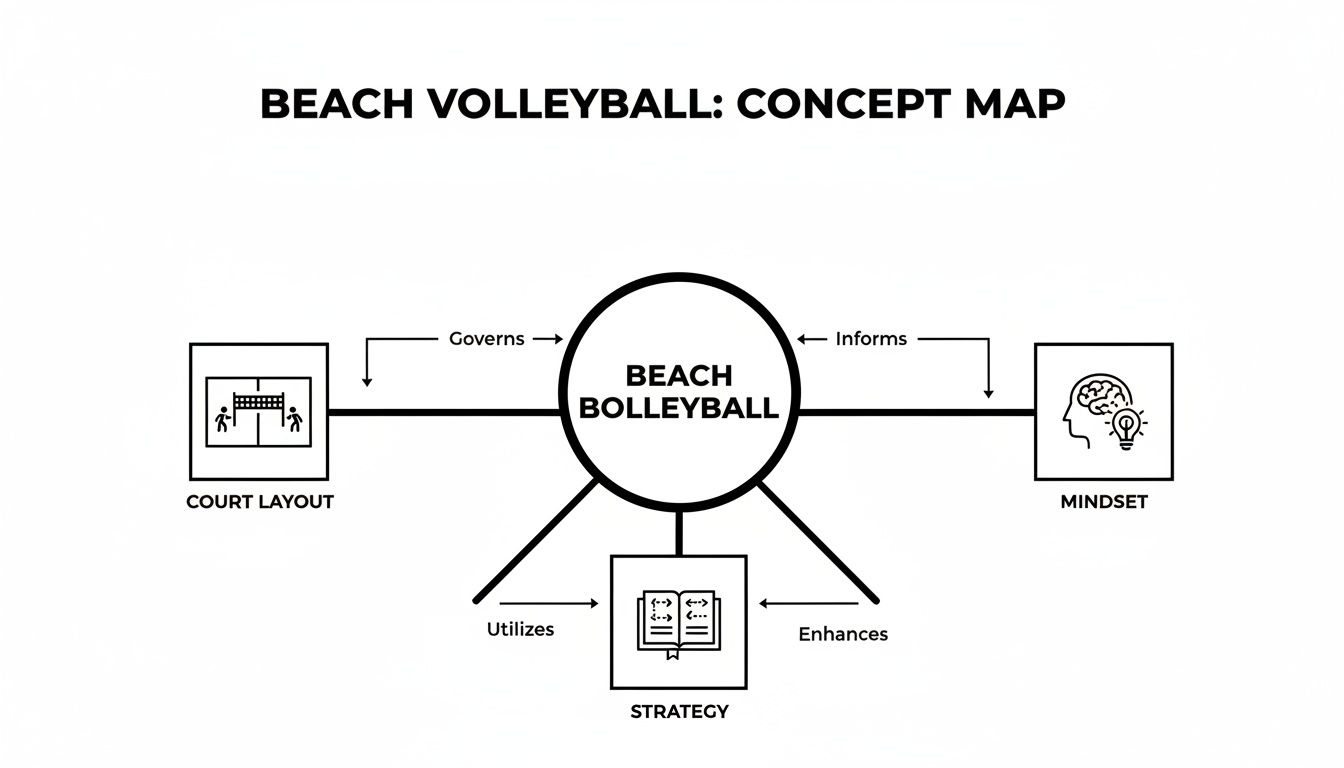
As you can see, the physical court is just one piece of the puzzle. How you think and plan within that space is what separates good players from great ones.
To give you a quick reference, here are the official specs all in one place.
Official Beach Volleyball Court Specifications At A Glance
This table summarises the key measurements set by the FIVB for competitive play. These numbers define the battlefield for every official match, from local tournaments to the Olympic Games.
| Specification | Measurement |
|---|---|
| Playing Court | 8m x 16m (26.2 ft x 52.5 ft) |
| Men's Net Height | 2.43m (7 ft, 11 5/8 in) |
| Women's Net Height | 2.24m (7 ft, 4 1/8 in) |
| Minimum Free Zone | 3m (9.8 ft) on all sides |
| FIVB World Comp. Free Zone | 5-6m (16.4-19.7 ft) |
| Minimum Overhead Clearance | 7m (23 ft) |
Knowing these numbers isn't just for trivia—it helps you understand why certain plays work and how to use the space to your advantage.
Net Height and Why It Matters
The net is where the war is won. It’s the physical barrier that defines offence and defence, and its height is set specifically to create a fair challenge.
- For Men: The net is set at a towering 2.43 metres (7 feet, 11 5/8 inches). To hit or block effectively at this height, you need some serious hops.
- For Women: The net is slightly lower at 2.24 metres (7 feet, 4 1/8 inches). Don't be fooled, though—it still demands incredible timing and power to dominate at the net.
These heights are always measured from the centre of the court. A player's whole game at the net—their ability to put up a solid block or spike the ball down—is a direct result of their athleticism and how well they've learned to work with this vertical barrier.
The Free Zone and Overhead Clearance
The game doesn't end when the ball goes out of bounds. That space surrounding the court is called the free zone, and it’s where some of the most spectacular defensive plays happen. Chasing down a wild pass or making a last-ditch diving save all happens here, so it needs to be clear of any obstructions.
According to official regulations, the free zone should extend a minimum of 3 metres (9.8 feet) on all sides. For world-class competitions, this expands to 5-6 metres (16.4-19.7 feet), giving elite athletes the space they need for those incredible recoveries you see on TV.
Just as important is what’s happening above the court. You need at least 7 metres (23 feet) of clear space overhead. This ensures that sky-ball serves, high sets, and looping defensive shots don’t get interrupted by a low-hanging tree branch or ceiling beam.
If you’re on the hunt for a court that ticks all these boxes, our guide on how to find sand volleyball courts near you is packed with tips for finding top-notch facilities.
Getting these technical specs down is the first step to playing at a higher level. It turns a patch of sand into a tactical map where you can control the game, read your opponent, and execute your strategy with confidence.
The Science of Sand and Why It Changes Everything
Let's be honest, the heart and soul of any beach volleyball court isn't the net or the lines—it's the sand. The surface under your feet dictates the entire pace and style of the game. It turns a simple patch of ground into a dynamic, challenging arena. But not all sand is created equal, and understanding its science is what separates good players from great ones.
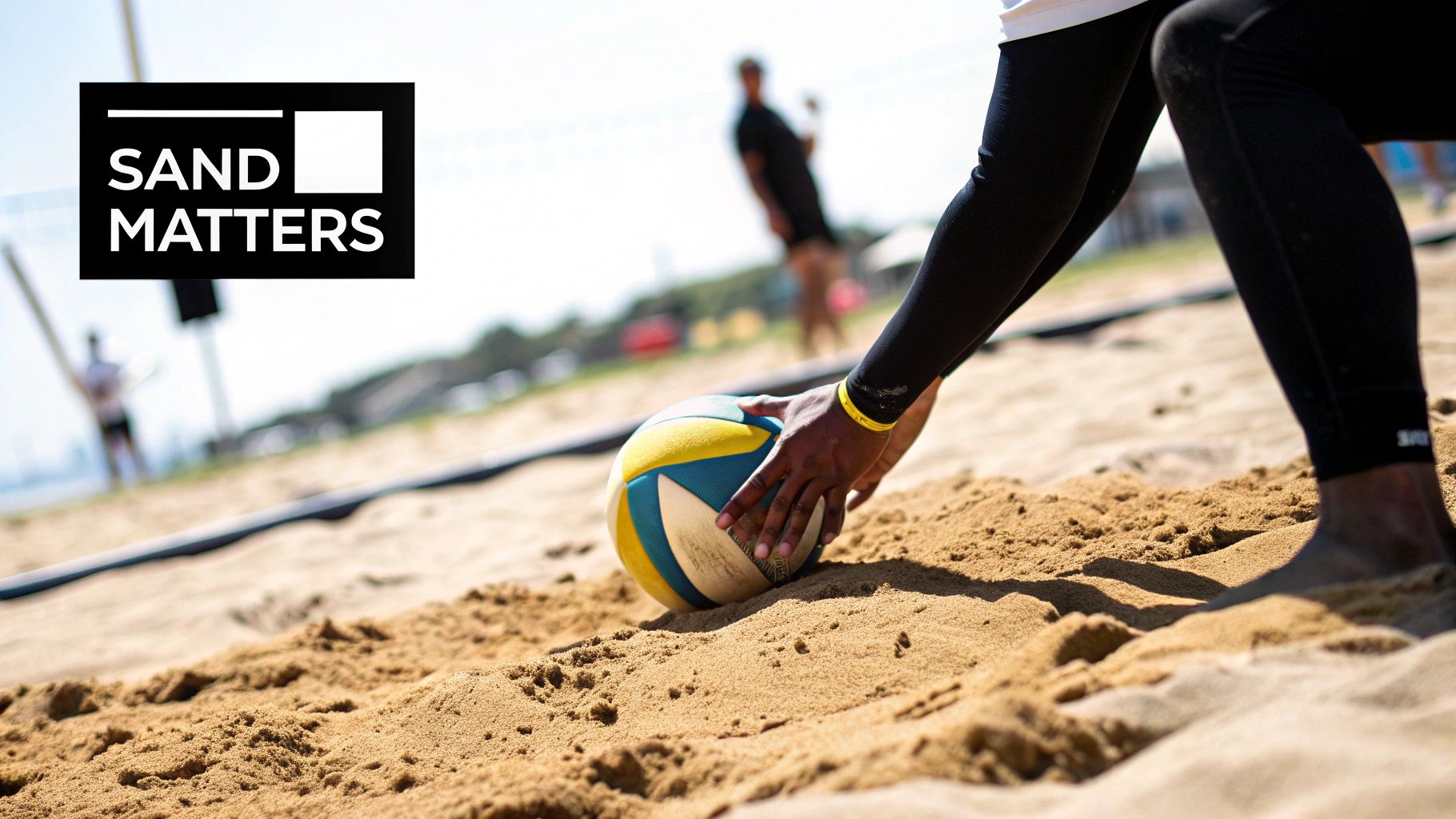
The ideal playing surface is made of fine, washed sand with rounded or sub-angular grains. Crucially, it must be completely free of sharp shells, rocks, or other nasty surprises. This isn't just about comfort; it's a massive safety issue. A well-maintained court with the right sand dramatically reduces the risk of cuts and scrapes when you dive for a ball.
This focus on safety and quality is a huge reason why serious players flock to top-tier training camps. You can train at maximum intensity on pristine, regularly sifted courts without worrying about landing on hidden glass or nails—a real problem on some public beaches. The difference is night and day. If you want to see what that looks like, you can explore a wide range of camps with high-quality facilities on MyNextCamp.
Sand Depth: The Real Game Changer
Imagine trying to jump in waist-deep water versus ankle-deep water. That's a perfect analogy for the difference between deep, soft sand and shallow, firm sand. The depth and composition of the court surface directly impact your movement, endurance, and power.
- Deep, Soft Sand (30-50 cm or more): This is the ultimate athletic test. Deep sand eats up energy like crazy, forcing your muscles to work much harder to generate explosive power for every jump and sprint. It creates a slower-paced, more physically punishing game that rewards endurance and powerful shots.
- Shallow, Firm Sand (less than 30 cm): This surface plays much, much faster. It gives you a more stable base, allowing for quicker movements, faster transitions, and a more reactive defensive game. Players can move with far more agility, which often leads to rapid-fire rallies.
Knowing the sand conditions before a match gives you a massive tactical advantage. If you're on deep sand, you need to conserve energy and rely on smart shot placement. On a firm court, speed and reaction time become the keys to winning.
Adjusting your play style to the sand is a core skill in beach volleyball. A team that fails to adapt their strategy to the court's surface is giving their opponent an immediate and significant advantage.
How Sand Shapes Your Training and Tactics
The type of sand on your home beach volleyball court directly shapes you as a player. If you consistently train on one type of surface, you'll build specific strengths, but you might also develop blind spots that leave you unprepared for different conditions.
To become a truly versatile player, you have to train on varied surfaces. If you only ever practise on firm, shallow sand, you’ll likely struggle with fatigue and a lower vertical jump when you finally compete on a deep, professional-level court. On the flip side, if you only train in deep sand, you risk being outpaced and outmanoeuvred on a faster court.
This is where sports psychology comes into play. Arriving at a tournament and finding the sand is completely different from what you're used to can throw you off your game. The best players prepare for this by:
- Conditioning for Adaptability: They incorporate plyometrics and endurance training specifically to handle any sand depth.
- Visualising Success: They mentally rehearse playing on different surfaces long before the competition starts.
- Focusing on Controllables: They accept the court conditions and shift their focus to tactics and communication with their partner—things they can actually control.
Ultimately, the sand is more than just a surface; it's an active participant in every single point. From the physical toll it takes on your body to the strategic adjustments it demands, mastering the science of sand is essential for anyone looking to elevate their game.
Mastering Court Strategy and Team Tactics
A beach volleyball court isn't just a rectangle of sand; it's a strategic battlefield. Once you understand the basic dimensions and how the sand plays, the real game begins. This is where you turn that knowledge into a weapon, transforming a simple game of pass, set, hit into a high-speed chess match where every inch of the court is contested.
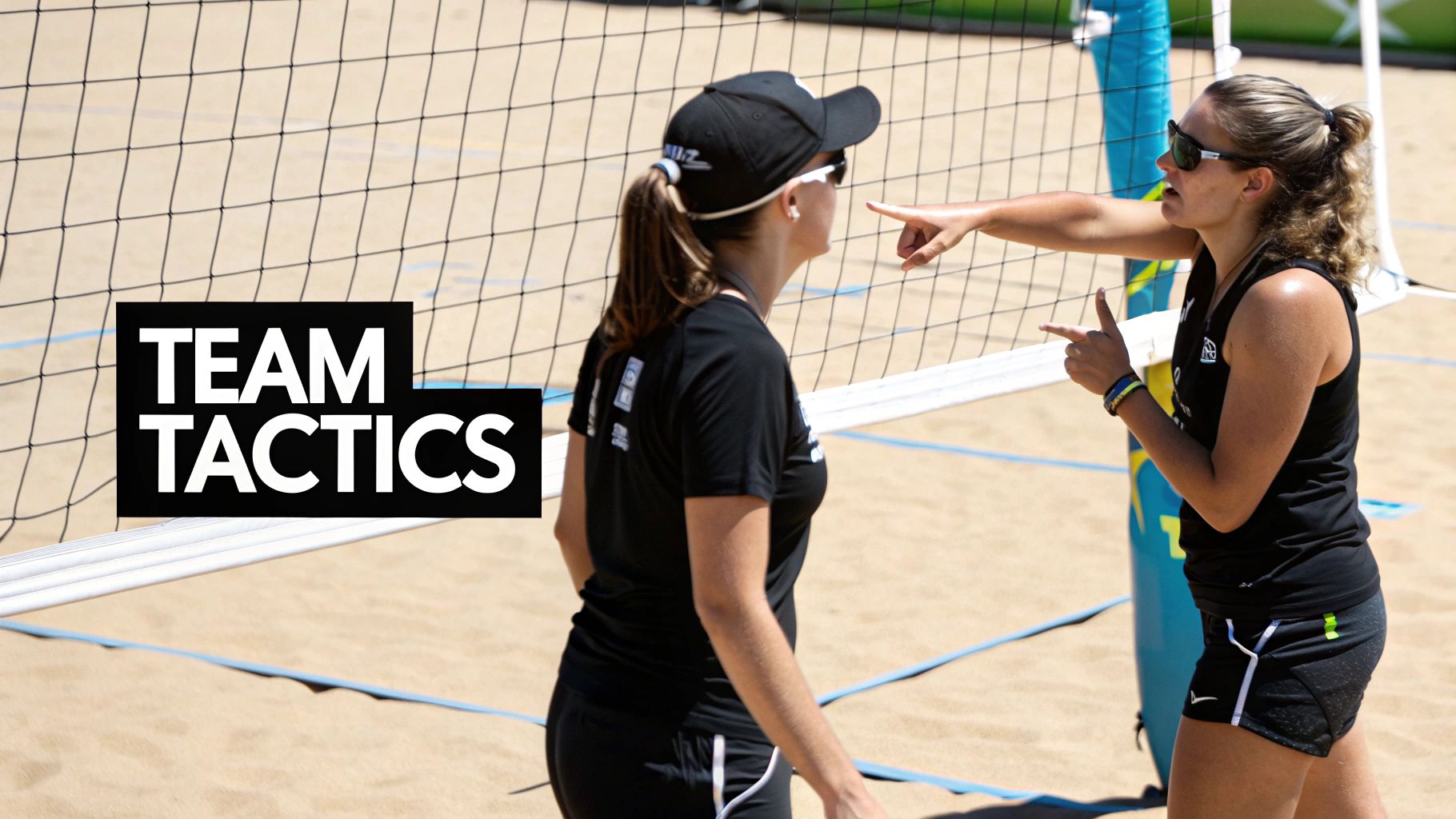
Winning strategy has little to do with raw power and everything to do with creating and controlling space. It’s about forcing your opponents into awkward spots and then executing with precision. That requires an almost telepathic connection with your partner, where you both know what the other is thinking before a word is spoken.
Advanced Offensive Tactics to Control the Game
At its core, beach volleyball offence is about making two people cover a huge amount of court. The main objective is always to create open space. The best teams do this with an attack that’s as varied as it is unpredictable.
Spreading the court is the first principle. By alternating between deep shots to the corners and sharp, angled attacks, you force the defenders to constantly shift their positions. This relentless movement wears them down physically and mentally, eventually creating the gaps you’re looking for. If you want a visual masterclass on creating these angles, the instructional videos from Better at Beach are a fantastic resource, with breakdowns from pro players and coaches.
But it’s not all about hitting hard. Deceptive shots are what keep the defence guessing.
- The Roll Shot: This is a soft, arcing shot hit with topspin that’s designed to drop right over the blocker’s hands and in front of the back-court defender. It’s the perfect answer when the defence is sitting back, waiting for a power swing.
- The Poke (or Cobra): A quick, one-handed push with your knuckles or fingertips. It’s not about power; it’s about placing the ball precisely into an undefended spot. Pure surprise.
"The best offence is a diverse offence. If your opponent never knows whether you're going to hit hard, shoot deep, or drop it short, you control the rally before you even contact the ball."
This variety is mentally exhausting for the other team. It forces them into a guessing game, creating hesitation and second-guessing their reads—and that’s exactly the psychological edge you want to have.
Defensive Systems and Partner Communication
On defence, coordination is everything. The blocker and the defender have to operate like a single unit to have any chance of covering the court. The blocker’s job isn't just to stuff the ball; it's to strategically take away one part of the court, funnelling the attack exactly where their partner is waiting.
A classic defensive setup has the blocker taking away either the "line" shot (down the sideline) or the "angle" shot (cross-court). The defender then shades over to cover the remaining open space. This decision is often communicated silently with hand signals behind the blocker's back just before the serve.
Clear, concise communication during the rally is absolutely non-negotiable. Quick shouts of "line," "angle," or "mine" need to be instant and decisive. Any hesitation spells disaster and usually a point for the other team. Mastering this dialogue builds the trust that allows a team to move as one fluid unit. It’s a skill that needs just as much practice as your passing or hitting. And to make sure you have the physicality to back up these strategies, check out our guide on how to get a higher vertical jump—a huge asset for any blocker or defender.
The Role of Sports Psychology in Court Awareness
Finally, strategy and sports psychology are two sides of the same coin. The ability to stay focused under pressure, to read an opponent’s body language, and to keep a positive mindset is what allows a team to execute their game plan when it matters most.
Top players are constantly processing information. They’re watching the setter’s approach to the ball, the hitter's shoulder turn, and their position on the beach volleyball court to anticipate the attack. This isn't just guesswork; it's pattern recognition built from thousands of hours of practice.
Managing the mental game is what separates good teams from great ones. After making an error, the best teams reset instantly. They’re focused on the next point, not the last one. They use visualisation techniques to mentally rehearse successful plays and build confidence. This mental toughness ensures that one bad point doesn't spiral into a lost game. Your side of the net is your domain—controlling it both physically and mentally is the key to winning.
Winning the Mental Game on Your Side of the Net
The best players don’t just own the physical space of a beach volleyball court—they dominate the mental space within it. Sports psychology is that invisible edge that separates good teams from champions. It’s about forging mental toughness, keeping a razor-sharp focus when the pressure mounts, and building a partnership that actually gets stronger when the score gets tight.
This entire mental game is built on a simple, yet incredibly powerful idea: control what you can control. You can’t do a thing about a bad call, a lucky shot from your opponent, or a sudden gust of wind that sends your serve wide. But what you can always control is your own effort, your attitude, and the game plan you execute with your partner. Getting this right is the secret to owning your side of the net, no matter what’s happening on the other.
Building a Resilient Partnership Through Communication
In a two-person team, communication isn't just a good idea; it's everything. When things get heated, solid communication is the glue that holds a partnership together. It has to be clear, concise, and constructive—especially right after a mistake.
Pointing fingers after a missed ball is the fastest way to lose a match. It’s a complete momentum killer. Instead, the top teams use simple, forward-looking phrases. Rather than yelling, "You should have got that!", a better approach is, "Next time, I'll cover the line, you take the angle." See the difference? It shifts the focus from blame to a collaborative fix for the very next point. For more on this, the experts at Volleyball Magazine often have great articles from sports psychologists on team cohesion.
This constant, positive dialogue is what builds resilience. It creates a space where both players feel supported, which frees them up to take risks and play aggressively without worrying about getting chewed out.
Techniques for Managing In-Game Pressure
Match point. This is where mental grit is truly tested. The pressure can feel crushing, but the best players have routines to stay calm and locked in. One of the most effective tools is a simple reset routine.
A reset routine is just a small, repeatable sequence of actions you do between points to clear your head. It could be as simple as this:
- Take one deep, slow breath to bring your heart rate down.
- Make direct eye contact with your partner for a quick nod or strategy confirmation.
- Visualise the perfect serve or pass you're about to make.
This tiny ritual breaks the cycle of negative thoughts that can spiral after an error. It pulls you back into the present moment, forcing you to focus entirely on the next point—which is always the only one that matters.
The ability to bounce back from an error instantly is what defines an elite player. They treat each point as a new beginning, completely independent of the last one.
Another powerful technique is visualisation. Before a big match, spend a few minutes mentally rehearsing key moments. Picture yourself on the beach volleyball court, ripping an ace at a critical time or making that perfect defensive dig. This mental practice builds a library of success in your mind, so when the real situation arrives, it feels familiar and totally manageable.
Cultivating an Unshakable Mindset
At the end of the day, the mental game is a skill. It requires just as much practice as your serve or your swing. It’s all about cultivating an unshakeable belief in yourself and your partner, built on a foundation of solid preparation, trust, and a relentless focus on the present.
Think of your mind as your most important piece of gear. Just like you take care of your body, you need to train your mind to be strong, flexible, and resilient. By focusing on clear communication, managing pressure with proven techniques, and building a mindset that controls the controllables, you can turn your side of the court into a fortress—both physically and mentally. That's what really makes a winning team.
How to Find and Choose the Right Beach Volleyball Court
Knowing the theory is one thing, but finding the perfect beach volleyball court to actually play on is a whole other game. Whether you're hunting for a spot for a casual weekend match or meticulously vetting a facility for a training camp, the quality of the court can make or break the entire experience. It’s not just about finding any patch of sand; it’s about finding the right sand and setup.
A quality facility is so much more than a net strung between two poles. You’ve got to look for the little details that tell you if a place is well-maintained and safe. Think proper sand depth, equipment that’s in good nick, and whether there are basic amenities like showers or toilets nearby.
What to Look For in a Quality Facility
When you’re scouting a new court, start thinking like a pro. A few key indicators will tell you everything you need to know about a facility’s quality. Don’t be afraid to be a bit picky—your performance and, more importantly, your safety depend on it.
- Proper Sand Depth and Quality: The sand needs to be deep, at least 30-40 cm, and completely free of rocks, sharp shells, or other debris. Clean, well-sifted sand is what prevents injuries and gives you the confidence to dive and play aggressively.
- Well-Maintained Equipment: Check the net. Does it have the right tension and height? The poles should be sturdy and straight, not leaning over or covered in rust. You also want to see secure, clearly visible boundary lines.
- Essential Amenities: Little things make a big difference. Access to toilets, water fountains, and outdoor showers can massively improve a training session, especially on a scorching hot day.
Thankfully, the global standard for court accessibility is on the rise. Major sporting events often leave behind a legacy of top-notch infrastructure. Take the Birmingham 2022 Commonwealth Games, for example. In its wake, Volleyball England established a network of eight Beach Volleyball Development Centres. This single initiative has played a huge role in the sport's growth, with an estimated 172,968 people playing volleyball in England between late 2023 and 2024. You can read more about it in Volleyball England's annual report.
Selecting Courts for Training Camps
If you're looking to seriously level up your game, the quality of the court at a training camp is non-negotiable. As you browse camps, make facility standards one of your main filters. The best camps will proudly show off their pristine courts because they know it's a huge selling point. They understand that a professional-grade beach volleyball court allows athletes to train harder, safer, and far more effectively.
For instance, when you’re comparing beach volleyball camps in amazing destinations like Portimão, Portugal, dig into the camp description for details on court maintenance and sand quality.
When you invest in a training camp, you're investing in an environment built for peak performance. The court is the heart of that environment, and its quality has a direct impact on the value you get from your coaching.
Tips for Organisers Setting Up Courts
Now, if you're on the other side and organising a tournament or a camp, that responsibility for quality lands squarely on you. To meet competitive standards, you have to nail the details. Sift the sand regularly to clear out any hazards, invest in high-quality, adjustable net systems, and make sure your boundary lines are set to official dimensions. Providing a top-tier playing experience doesn't just attract more players—it builds a reputation for excellence that people will remember.
Your Top Beach Volleyball Court Questions, Answered
Alright, let's wrap this up by hitting some of the most common questions players ask about courts. Think of this as your quick-reference guide for the next time you step onto the sand.
What Is the Official Net Height for Beach Volleyball?
This is a classic, and there are two numbers you need to know. For men's competition, the official net height is 2.43 metres (7 feet 11 5/8 inches). For women's games, it's set a bit lower at 2.24 metres (7 feet 4 1/8 inches).
And a pro tip: this measurement is always taken from the absolute centre of the court, where the net might sag just a tiny bit.
Can I Just Use Any Kind of Sand for a Court?
Technically, you can play on almost anything, but for a proper court that's safe and performs well, the answer is a firm no. You need fine, washed sand with rounded, sub-angular grains.
This isn’t just about feeling nice on your feet. The right sand cushions your dives, reduces scrapes, and allows for proper drainage after rain. It should always be free of rocks and shells, with a solid depth of at least 30-40 cm. Anything less is an injury waiting to happen.
Are the Boundary Lines Considered In or Out?
They're in! In beach volleyball, the lines are part of the court. If a ball lands on any part of that line, it's a good ball and a point for the hitting team.
This simple rule is a massive part of high-level strategy. Hitting the lines on purpose is a skill that can win you tight matches.
Think of the lines as your allies. Using them effectively can turn a seemingly out ball into a crucial point, forcing defenders to cover every last centimetre of their side.
Why Did the Court Size Change to 8x16 Metres?
Back in 2001, the court dimensions were shrunk from the old 9x18m size, and it completely changed the game. The smaller beach volleyball court made the sport faster, more athletic, and way more exciting to watch.
With less ground to cover, two players are forced into longer rallies and more spectacular defensive plays. It was a brilliant move that shifted the balance from pure power to a dynamic mix of strategy, agility, and explosive action.
Ready to put this knowledge into practice? Find the perfect training environment and take your game to the next level with MyNextCamp. Explore hundreds of camps, filter by your specific needs, and book your next beach volleyball adventure at https://mynextcamp.io.
46 Aufrufe
Finde dein nächstes Camp
Vergleiche Beachvolleyball-Camps in ganz Europa. Filtere nach Land, Datum und Preis.